Texas Instruments (TI) is the undisputed cornerstone of modern electronics, commanding a dominant presence in the industrial, medical, and automotive sectors. From high-precision analog front-ends in diagnostic imaging to robust power management ICs in electric vehicle drivetrains, Texas Instruments chips are engineered into the very fabric of critical infrastructure. Because these components are often "designed-in" for their unique electrical characteristics and long-term reliability, TI has become a single point of failure for many global supply chains.
The true crisis emerges when these essential components reach End-of-Life (EOL) status. Unlike digital components that might have quick software workarounds, a discontinued TI analog chip can be a "showstopper" for production. Because analog circuitry is so sensitive to noise and voltage tolerances, finding a replacement isn't just a procurement task—it's a high-stakes engineering challenge. When the authorized channel goes dry, the sudden obsolescence of a single TI part can trigger a ripple effect of production delays and astronomical redesign costs, leaving manufacturers in a desperate race to find hard-to-find TI chips before their assembly lines grind to a halt.
What Are Obsolete Texas Instruments Components?
In the semiconductor industry, "obsolete" is more than just a descriptive word; it is a specific regulatory and manufacturing status. For Texas Instruments, the transition from a flagship product to an obsolete one follows a structured lifecycle. Understanding the official terminology used by TI is essential for procurement managers to determine whether a part is simply difficult to find or if it has officially entered its "final sunset."
Decoding TI Lifecycle Status: NRND vs. EOL
Texas Instruments categorizes its components into several stages to help engineers and buyers manage long-term availability. The two most critical "warning" statuses are:
NRND (Not Recommended for New Designs): When a TI part is marked as NRND, it is still in production, but the "clock is ticking." TI is effectively telling engineers: "We will still make this for current customers, but do not use it for new projects." This is often the first signal that a part is moving toward obsolescence, as production priority shifts to newer generations.
EOL (End-of-Life): This is the definitive status. Once a part is EOL, TI has officially decided to stop manufacturing it. At this stage, the component is no longer available from the factory, and any remaining stock is held by distributors or sitting in excess inventory.
The Significance of the PDN (Product Discontinuance Notification)
The transition to EOL doesn't happen in secret. It is triggered by a formal document known as a PDN (Product Discontinuance Notification). In the TI supply chain, the PDN is a critical "early warning" that outlines the final roadmap for a specific part number:
Last Time Buy (LTB) Date: This is the absolute final deadline for customers to place orders with TI. Once this date passes, the order books are closed forever.
Last Time Ship (LTS) Date: The final date on which TI will fulfill and ship the remaining orders.
The Impact: For buyers, a PDN is a call to action. Missing the LTB window means you are officially entering the "obsolete sourcing" phase, where you must rely on independent distributors like NTCHIP to secure remaining global stocks.
Why Do Texas Instruments Parts Go Obsolete?
Understanding the "why" behind the obsolescence of Texas Instruments chips is crucial for long-term supply chain planning. Obsolescence is rarely a random event; it is usually a strategic move by the manufacturer driven by technological evolution, production efficiency, and global regulatory shifts.
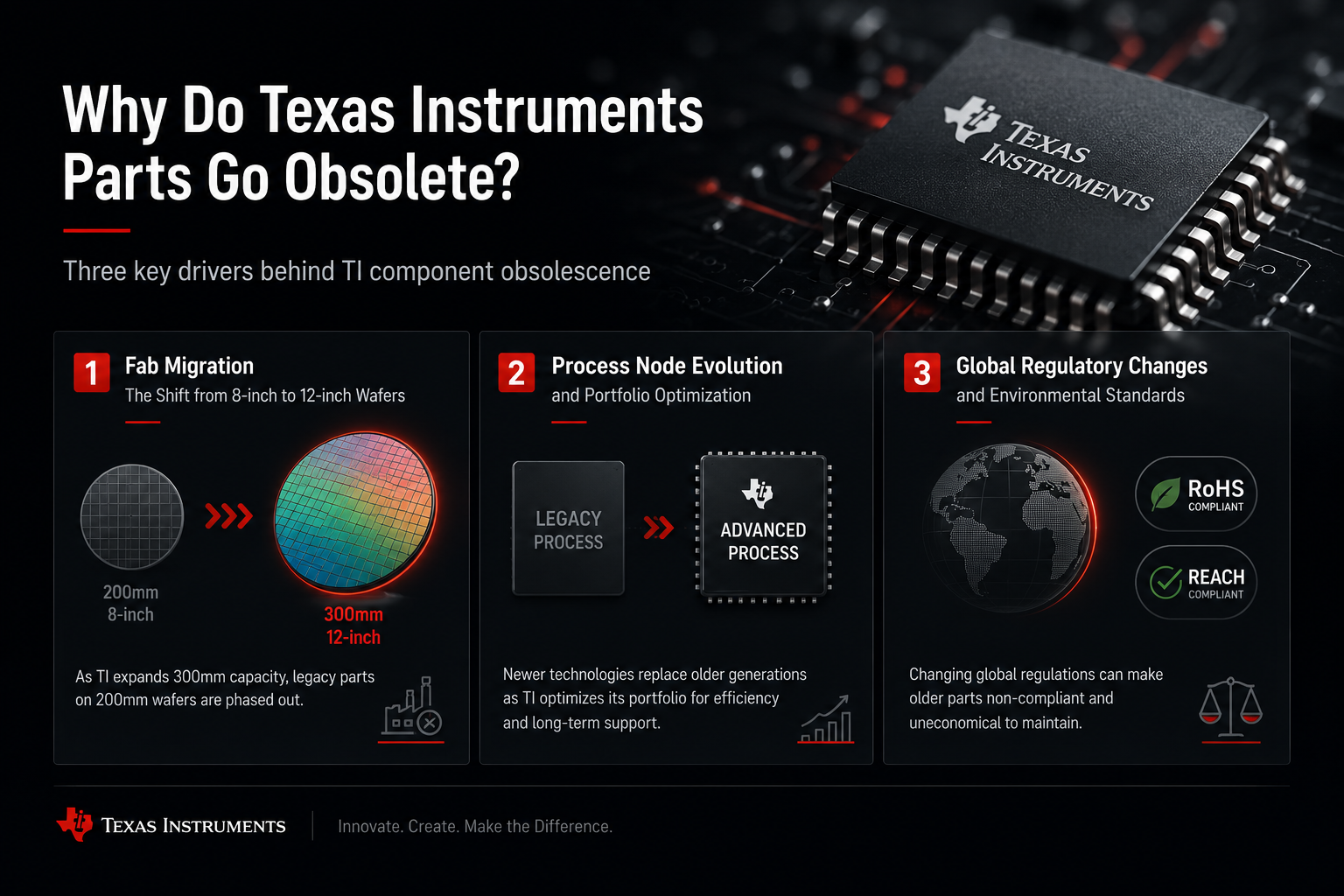
Here are the three primary drivers that cause reliable TI components to enter the "Hard-to-Find" market:
1. Fab Migration: The Shift from 8-inch to 12-inch Wafers
In recent years, Texas Instruments has aggressively expanded its 300mm (12-inch) wafer manufacturing capacity. While this move increases overall output, it often spells the end for older components produced on 200mm (8-inch) wafers.
The Efficiency Gap: Manufacturing on 12-inch wafers is significantly more cost-effective. As TI optimizes its newer "super-fabs," older equipment and production lines are decommissioned.
The Result: High-volume legacy parts that cannot be easily migrated to the newer, more advanced 300mm process nodes are eventually flagged for discontinuation.
2. Process Node Evolution and Portfolio Optimization
Technology waits for no one. As TI introduces newer, more efficient silicon architectures—such as moving from older sub-micron processes to more advanced nodes—older generations lose their "strategic value."
Rationalization: TI manages a massive catalog of tens of thousands of part numbers. To maintain high profit margins and streamline support, they periodically "prune" their portfolio, removing older versions of op-amps, power regulators, and logic gates that have been superseded by smaller, more energy-efficient alternatives.
Shrinking Support: As the specialized raw materials or older chemical masks required for legacy chips become harder for TI to source from their own sub-suppliers, they issue a PDN to close the line.
3. Global Regulatory Changes and Environmental Standards
Sometimes, obsolescence is forced by law rather than technology. Changes in global environmental mandates can overnight render a popular TI part "non-compliant."
RoHS and REACH Compliance: Updates to the "Restriction of Hazardous Substances" (RoHS) or other chemical safety standards often mean that older TI parts containing lead (Pb) or specific flame retardants can no longer be sold in key markets like the EU.
The Dilemma: If the cost to re-engineer a 20-year-old chip to meet new "Green" standards outweighs its projected sales, TI will choose to obsolete the part rather than update it.
Redesign vs. Sourcing: The Cost of TI Obsolescence
When a critical Texas Instruments chip is flagged as obsolete, engineering and procurement teams often find themselves at a crossroads: Should we hunt for the remaining original stock, or is it time to redesign the entire board?
While a redesign might seem like a "long-term fix," the hidden costs often make obsolete TI sourcing the more commercially viable strategy.
The Hidden Complexity of Analog Redesign
Unlike digital logic, where one microcontroller can often be swapped for another with a few code changes, TI’s analog and power components are deeply integrated into the physical hardware.
Sensitivity to Parameters: Analog circuits are designed around specific voltage offsets, gain levels, and thermal noise profiles unique to a TI part number. A "similar" replacement can lead to signal instability or power efficiency drops.
Testing Rigor: A new component requires a complete re-validation of the hardware. This includes stress testing, EMI/EMC compliance checks, and thermal profiling to ensure the new "equivalent" doesn't fail in the field.
Financial Impact: Why Sourcing Wins
For many manufacturers, the math simply favors sourcing original parts through trusted independent channels like NTCHIP:
Time-to-Market: A redesign can take 6 to 12 months from prototyping to mass production. Sourcing original hard-to-find TI chips can solve a production stoppage in days.
Certification Costs: In highly regulated industries—such as medical (FDA), aerospace (FAA), or automotive (IATF 16949)—any change to the Bill of Materials (BOM) requires expensive recertification. These costs can easily reach tens of thousands of dollars, far exceeding the premium paid for obsolete inventory.
Software Porting: If the obsolete part is an embedded processor or a specialized DSP, the cost of rewriting legacy code for a new architecture often represents hundreds of man-hours.
The "Life Extension" Strategy
By securing a strategic reserve of obsolete TI components, companies can extend the life of their legacy products without the risk of a redesign. This is particularly vital for industrial equipment that is expected to remain in service for 15+ years.
Expert Insight: Sourcing is not just a "stop-gap"—it is a strategic financial decision to protect your R&D investment and maintain consistent product performance without the variables introduced by new silicon.
4 Strategies to Find Hard-to-Find TI Chips
When the official TI storefront and your usual authorized distributors show "zero stock," it doesn't mean the component is extinct. It has simply moved from the primary market to the global supply chain's secondary layers.
To secure hard-to-find TI chips without compromising on quality, we recommend the following four proven strategies:
1. Leverage Independent Electronic Component Distributors
Independent distributors are the most effective resource for obsolete sourcing. Unlike authorized players who are tied to factory production lines, independent distributors like NTCHIP specialize in "open market" sourcing. We navigate a global network of vetted suppliers to locate stock that is no longer available through traditional channels, providing a lifeline for manufacturers facing production stops.
2. Access Global OEM Excess Inventory
Millions of original Texas Instruments parts are currently sitting in the climate-controlled warehouses of OEMs (Original Equipment Manufacturers) and EMS providers. This "Excess Inventory" often exists because a project was downsized or a product reached its end-of-life before the components were used. Professional distributors have the tools to track this "hidden" stock and bring it back into the active supply chain.
3. Seek Drop-in Replacements (Cross-References)
If the exact TI part number is truly unavailable, the next best step is a "Cross-Reference." This involves finding a part that is Pin-to-Pin compatible—meaning it can be soldered onto the same PCB footprint without hardware changes. While this often requires a engineering review of the datasheet (checking voltage offsets and noise levels), it can be a faster solution than a full redesign.
The best way to handle obsolescence is to see it coming. Modern procurement teams use lifecycle management software to monitor Product Discontinuance Notifications (PDN). By identifying "High Risk" TI parts early, you can execute a "Last Time Buy" or begin the sourcing process months before the authorized stock actually runs out.
Authorized vs. Independent Distributors for TI Parts
Understanding the difference between these two channels is critical for a balanced procurement strategy.
Authorized Distributors (e.g., Arrow, Avnet, Mouser): These are your primary partners for Active and High-Volume TI components. They receive stock directly from TI fabs. However, once a part is marked Obsolete, they clear their inventory and stop supporting the line.
Independent Distributors (e.g., NTCHIP): We are your partners for EOL, Obsolete, and Shortage situations. We don't rely on the factory's current production; instead, we specialize in quality-controlled sourcing from the global open market and excess networks. When the authorized channel says "No," the independent channel is where the solution is found.
How to Avoid Counterfeit Texas Instruments Chips
Because Texas Instruments chips are in such high demand, they are prime targets for counterfeiters. Sourcing obsolete parts requires an advanced level of vigilance. At NTCHIP, we implement a multi-layer inspection protocol to ensure every TI part is a genuine, factory-original component.
Critical Inspection Points for TI Components:
Top Marking & Laser Etching: Genuine TI chips use high-precision laser marking. We look for "blacktopping" (where the original surface is sanded off and reprinted), irregular fonts, or ink that smears when exposed to acetone.
Pin Condition: We inspect the leads for signs of "re-tinning" or oxidation. Original TI parts should have uniform, pristine pins that show no signs of having been previously soldered or refurbished.
Traceability & Labeling: We verify the 2D barcodes and lot codes on the packaging against TI’s historical manufacturing data.
Advanced Testing: For critical applications, we move beyond visual inspection to X-Ray Analysis (to verify internal die consistency) and Decapsulation, which reveals the TI logo etched directly onto the silicon wafer.
Why Trust NTCHIP for Your Obsolete TI Sourcing?

Finding obsolete Texas Instruments components is a challenge, but verifying their authenticity is an entirely different level of complexity. When you partner with NTCHIP, you aren't just buying parts; you are investing in a secure, transparent, and quality-driven supply chain. Here is why leading manufacturers trust us with their TI sourcing:
Global Sourcing Network and Real-Time Inventory
Through our proprietary global network, we track millions of original TI parts held in OEM excess and specialized buffer stocks worldwide. This allows us to find components that are marked as "zero stock" on every other platform.
ISO-Certified Quality Control (The NTCHIP Standard)
Every Texas Instruments part that enters our facility undergoes a multi-layer inspection protocol. Our in-house lab provides:
Visual & Marking Inspection: To detect re-tinning or "blacktopping."
X-Ray Analysis: To ensure internal die consistency.
Decapsulation: For 100% verification of the silicon wafer’s TI logo.
Risk Mitigation and Warranty
We stand behind our products. NTCHIP offers a 365-day warranty on all obsolete and hard-to-find components. If a part doesn't meet the original manufacturer's specifications, we handle the return and replacement process, ensuring your production remains risk-free.
Conclusion
In the world of semiconductor procurement, Texas Instruments obsolescence shouldn't be a reason for your assembly line to stop. While the challenges of EOL parts—from counterfeit risks to the high costs of redesign—are significant, they can be successfully managed with the right sourcing partner.
By shifting from a reactive "spot-buy" mentality to a proactive, quality-verified sourcing strategy, you can protect your R&D investments and extend the lifecycle of your most important products. Remember: the goal isn't just to find the part; it's to find the original, reliable part that guarantees your product's performance.
Ready to Solve Your TI Shortage?
Don't let a missing analog chip or power regulator delay your next shipment. NTCHIP is ready to help you navigate the complex market of obsolete electronics.
Submit Your RFQ: Send us your TI part numbers or upload your full BOM for a comprehensive availability check.
Talk to a Specialist: Contact our sourcing team today to discuss your specific requirements or to request a datasheet comparison.
Secure Your Stock: Get a Quote Now and experience the peace of mind that comes with certified, high-quality component sourcing.
FAQ Section
How do I check if a Texas Instruments part is obsolete?
The fastest way is to search the part number on the official TI website for its status (Active, NRND, or EOL). However, if the site shows it is discontinued, contact Nantian Electronics immediately to check if there is remaining stock in the global excess inventory or OEM warehouses.
Why are some TI chips so hard to find right now?
This is usually due to TI transition to 300mm wafer production, which causes many legacy parts on older 200mm lines to be phased out. High demand in the automotive and industrial EV sectors also diverts production capacity away from older analog models.
Can I trust "New Original" TI parts from independent distributors?
Yes, but only if the distributor has a certified QC process. At NTCHIP, we use X-ray and decapsulation to verify that "New Original" parts are factory-genuine and have not been refurbished or tampered with.
Is it possible to find a replacement for an obsolete TI component?
Often, yes. We can help you identify Pin-to-Pin (drop-in) replacements. However, for high-precision analog circuits, a direct sourcing of the original obsolete part is always safer than risking a board redesign.
Recommended reading


