Counterfeit electronic components are parts that are misrepresented as genuine, new, traceable, or conforming when they are not. They may be remarked, resurfaced, salvaged, mixed-lot, substituted, damaged, or altered in ways that are difficult to see during normal receiving.
For quality engineers, procurement managers, and MRO buyers, the practical question is not "Can one test prove authenticity?" It is "What level of inspection is reasonable for this part, supplier, application, and risk?"
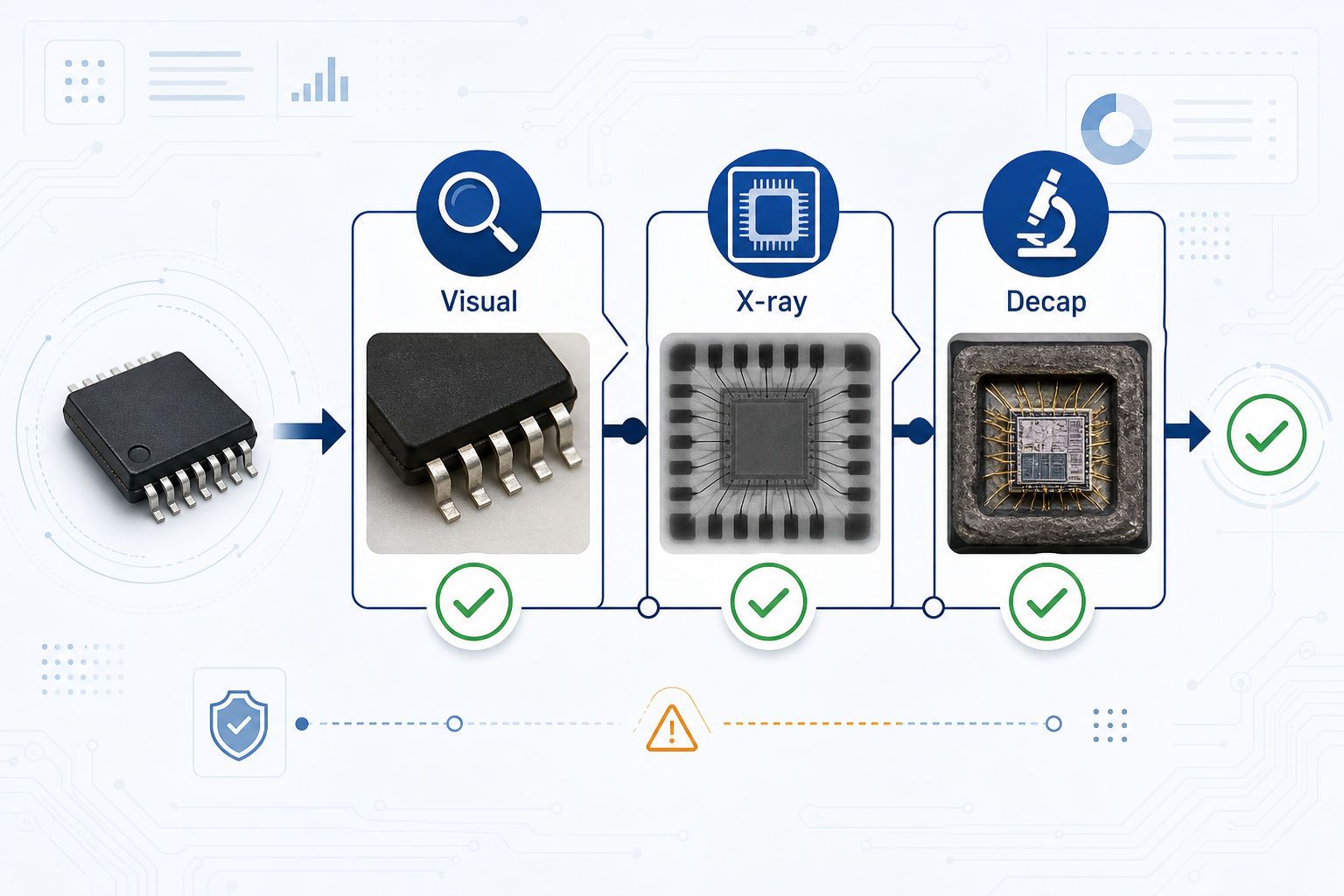
Visual inspection, X-ray inspection, and decapsulation each answer a different part of that question. Visual inspection checks external evidence. X-ray inspection looks inside the package without opening it. Decapsulation exposes the die and internal construction when the risk level justifies destructive analysis.
NTCHIP can help buyers review high-risk electronic components, compare documentation, and plan appropriate inspection steps before procurement teams move forward. Availability, pricing, lead time, and inspection requirements should be confirmed through RFQ.
Quick answer
The best way to identify counterfeit electronic components is to combine supplier review, documentation checks, and risk-based inspection. Visual inspection is usually the first step because it can find marking, packaging, lead, resurfacing, and handling problems. X-ray inspection is useful when buyers need non-destructive evidence of internal die, wire bond, or package differences. Decapsulation is used when the risk is higher and destructive inspection is acceptable.
No single method proves every part is authentic. A practical inspection plan should match the component type, lot value, application risk, sourcing channel, lifecycle status, and customer requirements.
For high-risk RFQs, buyers should define the required inspection level before shipment. NTCHIP's quality control process can support review of incoming condition, documentation, and inspection expectations for electronic component sourcing.

Why counterfeit electronic components enter procurement workflows
Counterfeit risk rises when buyers source outside normal channels, especially during shortages, urgent repair work, EOL support, or long-tail MRO demand. The part may be hard to find, the approved supplier may have no allocation, or the equipment may depend on an old component that is no longer supported by the manufacturer.
Common high-risk scenarios include:
Obsolete ICs needed for industrial repair or service-life extension.
Shortage-driven purchases from unfamiliar suppliers.
Mixed lots with inconsistent date codes, countries of origin, or packaging.
Parts advertised as new but recovered from used boards.
Components with altered markings, resurfaced packages, or inconsistent labels.
High-value semiconductors, power modules, memory ICs, relays, and connectors where substitution creates system risk.
Counterfeit parts can create immediate failures, intermittent failures, process delays, warranty disputes, and field reliability problems. They can also create hidden risk when a part appears functional during basic electrical checks but has a different die, prior use, moisture exposure, or package damage.
Procurement teams should treat counterfeit detection as a risk-reduction process rather than a single pass-or-fail event.
Visual inspection: the first screen for external evidence
Visual inspection is the first practical check for most incoming electronic components. It reviews the part body, leads, marking, packaging, labels, quantity, and documentation before more advanced inspection is considered.
Inspectors may look for:
Inconsistent top markings, logos, font style, orientation, or date code format.
Sanding, blacktopping, resurfacing, coating texture, or marking ink issues.
Scratches, bent leads, oxidation, solder residue, rework marks, or contamination.
Package dimensions, mold marks, pin count, and lead finish that do not match expectations.
Label mismatches between reel, tray, bag, carton, and paperwork.
Moisture barrier bag issues, ESD packaging problems, or unclear handling history.
Lot mixing, inconsistent quantities, or unusual repackaging.
Visual inspection is fast and non-destructive. It is especially useful for screening open-market purchases, obsolete parts, repair items, and any shipment with documentation gaps.
Its limitation is simple: good counterfeiters often focus on external appearance. A clean visual result does not prove the die, bond wires, internal structure, or electrical behavior is correct. For that reason, visual inspection should feed the risk decision rather than end the review.
X-ray inspection: non-destructive internal comparison
X-ray inspection helps teams look inside an electronic component without opening the package. It can reveal internal features that visual inspection cannot see.
X-ray review may identify:
Missing die or unexpected die size.
Different die position across a lot.
Wire bond count or routing differences.
Broken, lifted, or inconsistent bond wires.
Voids, delamination indicators, or package anomalies.
Lead frame differences between samples.
Evidence that parts in one shipment may not share the same internal construction.
This method is useful when the part is expensive, obsolete, safety relevant, or sourced from a channel where documentation is limited. It can also help compare suspicious samples against known-good references when a proper reference is available.
X-ray inspection has limits. It may not confirm die markings, circuit function, parametric performance, or subtle material problems. The result also depends on package type, equipment capability, operator skill, image quality, and the availability of a known-good comparison.
Buyers should define what they expect X-ray inspection to answer before requesting it. "Check authenticity" is too broad. "Compare die size and wire bond pattern against approved reference samples" is more useful.
Decapsulation: destructive inspection for higher-risk decisions
Decapsulation removes or opens the package material to expose the die and internal construction. It is a destructive method, so it should be used when the risk level justifies losing sample parts.
Decapsulation may help confirm:
Whether a die is present.
Whether die markings, layout, or size appear consistent with expectations.
Whether bond wires and internal construction match the expected package family.
Whether the part appears to be a different device inside the correct-looking package.
Whether internal corrosion, contamination, or damage is present.
Decapsulation is often considered when visual inspection or X-ray results raise questions, when a lot is high value, when failure consequences are serious, or when a customer requires deeper evidence before accepting parts.
Its limitations matter. Decapsulation consumes sample parts, requires trained handling, and may still need electrical testing, datasheet review, or manufacturer comparison to support a final decision. It should not be described as a universal guarantee of authenticity.
Visual inspection vs X-ray vs decapsulation
| Method | What it checks | Best use case | Non-destructive? | Main strengths | Main limitations |
|---|
| Visual inspection | Marking, surface condition, leads, packaging, labels, documentation | First incoming screen for high-risk or open-market parts | Yes | Fast, practical, low disruption, catches many external red flags | Cannot verify die, bond wires, or internal construction |
| X-ray inspection | Die presence, die size, wire bonds, lead frame, internal package structure | Deeper review when visual results or sourcing risk justify internal evidence | Yes | Shows internal construction without opening the part | May not identify die markings, function, subtle material issues, or all counterfeit types |
| Decapsulation | Exposed die, die markings, internal construction, corrosion, contamination | High-risk lots, disputed parts, destructive sample analysis | No | Provides direct internal access for selected samples | Destroys samples and still may need reference comparison or electrical testing |
The right method depends on risk. A low-value passive component with strong supplier history may not need the same inspection plan as an obsolete IC sourced for a critical repair. A high-risk lot may need visual inspection first, X-ray review next, and decapsulation only for selected samples or unresolved findings.
Inspection checklist for quality, procurement, and MRO teams
Use this checklist before accepting high-risk electronic components:
| Checkpoint | What to confirm | Why it matters |
|---|
| Supplier identity | Company details, sourcing channel, communication history | Unknown suppliers increase documentation and quality risk |
| Full part number | Manufacturer, prefix, suffix, package, temperature grade, revision if applicable | Small suffix differences can change package, rating, or fit |
| Lifecycle status | Active, NRND, EOL, obsolete, or last-time-buy status | EOL parts often create open-market sourcing risk |
| Quantity and lot | Quantity, date code, lot code, country of origin, mixed-lot status | Lot inconsistency can signal repackaging or mixed sources |
| Packaging | Reel, tray, tube, MBB, ESD bag, label, seal condition | Packaging condition can reveal handling or repackaging issues |
| Visual condition | Marking, surface texture, leads, oxidation, solder residue | External defects are often the first counterfeit clue |
| Documentation | Packing list, CoC if provided, photos, test or inspection requirements | Documentation should support the buyer's acceptance decision |
| Inspection method | Visual, X-ray, decapsulation, electrical testing, or combined plan | The method should match the risk level and customer requirement |
| Disposition | Accept, hold, quarantine, return, or escalate | Suspect parts should not move into production by default |
Quality engineers should document inspection findings with photos and lot-level notes. Procurement managers should make inspection requirements part of the RFQ. MRO buyers should be especially careful when parts support equipment that is old, costly to stop, or difficult to repair.

How NTCHIP supports high-risk component inspection
NTCHIP supports global buyers who need to source electronic components with practical quality-control awareness. For high-risk parts, NTCHIP can help review the sourcing context, requested documentation, incoming condition, and inspection expectations before an order moves forward.
Useful RFQ details include:
Manufacturer and full part number.
Required quantity and acceptable date code range.
Package type, grade, and application notes.
Target delivery date and country of use.
Whether mixed lots are acceptable.
Whether visual inspection, X-ray inspection, decapsulation, or electrical testing is requested.
Any customer-specific acceptance criteria.
For procurement support, buyers can review NTCHIP's electronic components sourcing scope, send a request for quote, or contact NTCHIP with quality requirements for a specific BOM or part number.
NTCHIP should not be treated as a substitute for the manufacturer's own documentation, application approval, or customer quality system. Buyers should verify manufacturer, part number, package, date code, lifecycle status, datasheet, and test requirements before purchase.
External references buyers can use
Several industry resources can help teams frame counterfeit avoidance and inspection requirements.
SAE AS5553 covers counterfeit electronic parts avoidance, detection, mitigation, and disposition for aerospace and electronic supply chain contexts.
IDEA-STD-1010 focuses on acceptability of electronic components distributed in the open market and is widely associated with visual inspection practices.
NASA MSFC-STD-3619 is a public standard for counterfeit EEE parts avoidance, detection, mitigation, and disposition in space flight and critical ground support hardware.
These references do not automatically apply to every commercial purchase, and they do not prove any supplier's certification status. They are useful starting points for inspection language, risk assessment, and internal quality discussions.
FAQ
What are counterfeit electronic components?
Counterfeit electronic components are parts that are represented as genuine, new, conforming, or traceable when they are not. They may be remarked, resurfaced, recovered from used equipment, substituted, mixed with other lots, or altered to mislead the buyer.
Can visual inspection identify all counterfeit parts?
No. Visual inspection can find many external warning signs, such as marking issues, resurfacing, bent leads, oxidation, solder residue, and packaging inconsistencies. It cannot verify every internal or electrical characteristic.
When should buyers request X-ray inspection?
Buyers should consider X-ray inspection when parts are high value, obsolete, application sensitive, sourced through higher-risk channels, or visually suspicious. X-ray inspection is useful when internal structure matters and the team needs a non-destructive review.
Is decapsulation always required?
No. Decapsulation is destructive and usually reserved for higher-risk lots, disputed findings, or cases where visual and X-ray inspection do not provide enough confidence. It should be planned at the sample level.
Does passing inspection guarantee authenticity?
No inspection method should be treated as a 100 percent authenticity guarantee. Inspection reduces risk and supports a documented acceptance decision. Buyers should combine supplier review, documentation, inspection, electrical testing when needed, and application-specific quality requirements.
What should be included in an RFQ for high-risk parts?
Include manufacturer, full part number, quantity, package, target date, acceptable date codes, lifecycle concerns, documentation needs, and any requested inspection methods. If the part supports a critical repair or regulated product, state the quality requirements clearly before purchase.
Conclusion: inspect risk before it reaches production
Counterfeit electronic components are difficult to manage because the risk often appears before the part reaches engineering. A rushed RFQ, unclear supplier history, mixed lots, weak documentation, or missing inspection plan can move the problem into receiving, production, or field service.
Visual inspection, X-ray inspection, and decapsulation each help answer a different question. Visual inspection checks the outside. X-ray inspection reviews internal structure without opening the part. Decapsulation gives deeper access when destructive sample analysis is justified.
For high-risk parts, the strongest approach is to define inspection expectations before procurement is complete.
Ask NTCHIP to inspect high-risk parts by sending the full part number, quantity, target date, and quality requirements through the RFQ page.


