Instant Quote for Hard-to-Find Components
Struggling with EOL parts or a "Line Down" situation? Get a response from our global sourcing team in less than 24 hours.
Why Trust Nantian Electronics?
ISO9001:2015 / 14001 / 45001
Our triple ISO certifications and Dun & Bradstreet verification ensure the highest level of supply chain integrity and operational safety.

In the complex world of electronic manufacturing, a single missing component can bring a multi-million-dollar assembly line to a grinding halt. When a standard part suddenly disappears from authorized distributors' shelves, procurement teams are thrown into a high-stakes race against time.
Whether it is a critical microcontroller, a specialized capacitor, or a legacy memory chip, sourcing "hard-to-find" electronic components is one of the most stressful challenges in supply chain management. This guide will walk you through the root causes of these shortages, the hidden risks of the open market, and the most reliable strategies to secure the parts you need without compromising on quality.
What Defines a "Hard-to-Find" Electronic Component?
It is a common misconception that "hard-to-find" is simply another word for "obsolete." While End-of-Life (EOL) parts certainly fall into this category, a component can be in active, high-volume production and still be incredibly difficult to source.
A component is generally classified as "hard-to-find" under three main scenarios:
1. The Allocation Trap The original equipment manufacturer (OEM) is still producing the chip, but global demand heavily outweighs supply. When this happens, manufacturers place the part on "allocation." This means they prioritize their largest, Tier-1 customers (such as major automotive or smartphone brands). If you are a mid-sized buyer, your orders are pushed to the back of the queue, making the part impossible to buy through standard channels.
2. Lead-Time Blowouts In a stable market, standard lead times might hover around 8 to 12 weeks. However, during a supply chain shock—caused by raw material shortages, geopolitical tensions, or logistical bottlenecks—the lead time for an active component can instantly skyrocket to 50 weeks or more. For a factory needing parts for next month's production run, a 52-week wait means the part is effectively unavailable.
3. Abrupt Disruptions and EOL Sometimes, the shortage is sudden and unpredictable. A factory fire at a major silicon foundry, a natural disaster, or a sudden Product Discontinuation Notice (PDN) can wipe out global stock overnight. This transforms an everyday, cheap component into a rare and highly sought-after commodity.
When a component hits any of these three stages, franchised distributors will show zero inventory. At this point, buyers must pivot their strategy and enter the global open market to keep their production lines moving.
The Risks of Desperate Sourcing
When a production line is down, the pressure to find parts can lead to "panic buying." However, the open market for hard-to-find components is fraught with risks that can have long-term consequences for your brand’s reputation and product reliability.
Price Gouging and Market Volatility
In a shortage, the laws of supply and demand are amplified. You may encounter "grey market" brokers who inflate prices by 500% or even 1000% over the original MSRP. While paying a premium is often unavoidable for urgent needs, without a trusted partner, you risk paying "top dollar" for parts that may never even ship.
The Quality Compromise
The greatest danger is the influx of substandard parts. When components are scarce, fraudsters seize the opportunity to sell:
Salvaged Components: Parts pulled from old circuit boards, cleaned, and sold as "new."
Empty Packages: Components that look perfect on the outside but contain no silicon die inside.
Incorrect Specifications: Lower-grade parts remarked to look like high-performance or military-grade versions.
3 Reliable Channels for Sourcing Hard-to-Find Parts
To bypass the risks mentioned above, professional procurement teams move beyond simple Google searches and utilize these three strategic channels.
1. Global Stock Aggregators and Data Tools
Before contacting individual brokers, use professional database tools like NetComponents, SourceESB, or Octopart. These platforms aggregate the inventory of thousands of distributors worldwide.
2. Tapping into OEM Excess Inventory
One of the most reliable sources for hard-to-find parts is the excess stock of other manufacturers. An automotive factory in Europe might have a surplus of the exact microcontroller that a medical device company in Asia is desperately seeking. Specialized distributors act as the middleman here, helping you acquire factory-sealed, original-label parts that are sitting idle in another company's warehouse.
3. Specialized Independent Distributors
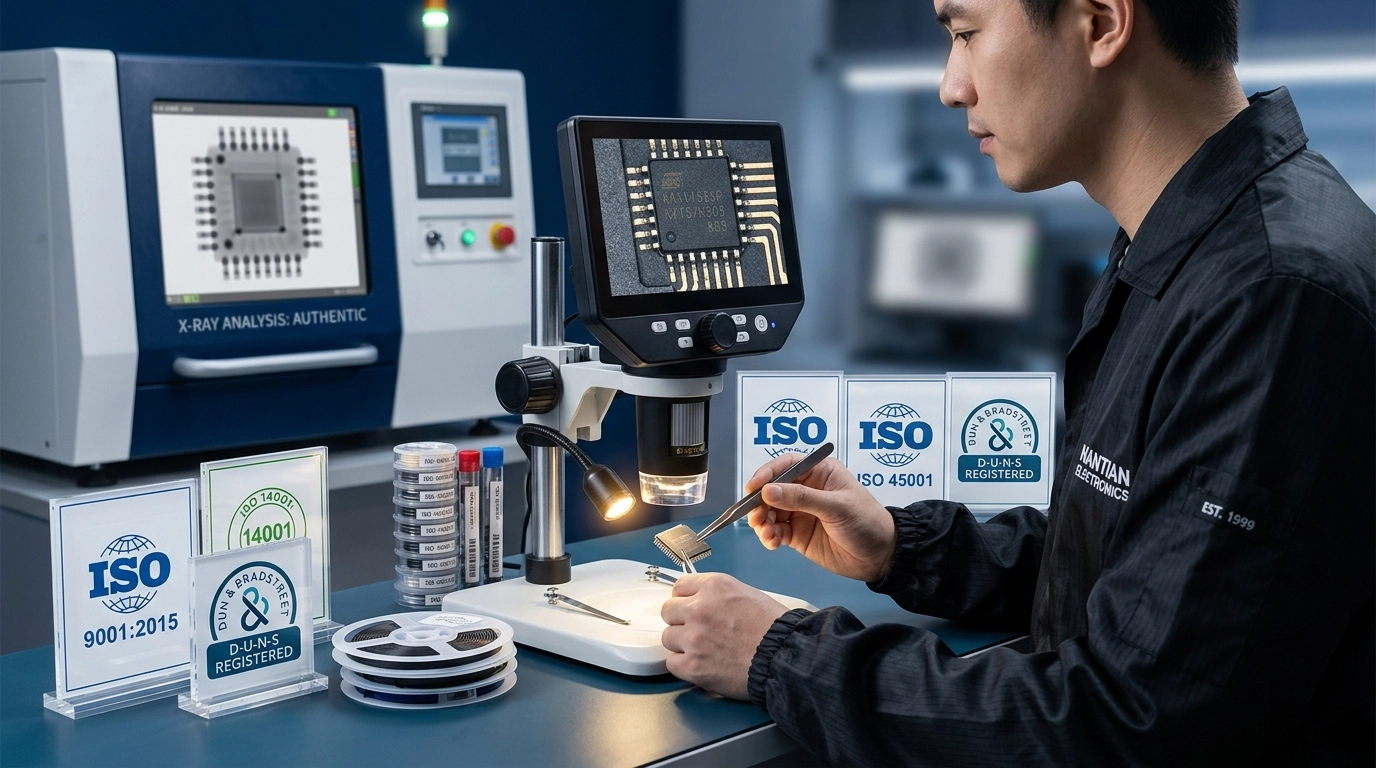
A top-tier independent distributor does more than just "find" parts; they act as a quality firewall. Unlike standard brokers, specialized distributors like Nantian Electronics maintain a global network of vetted suppliers and original equipment manufacturers (OEMs).
The Advantage: They can often access "hidden" inventory that isn't listed on public aggregators.
The Safety Net: They provide the necessary testing, such as X-ray and decapsulation, to ensure that the "hard-to-find" part you receive is 100% authentic.
Read More:
Verification is Key: How to Ensure Authenticity
When a component is "hard-to-find," the risk of encountering counterfeits increases exponentially. You cannot rely on a visual inspection alone. To protect your production line, a rigorous, multi-tier testing process is essential.
At Nantian Electronics, we follow a strict quality assurance protocol for every shortage component sourced from the open market:
Level 1: Visual Inspection & Packaging Analysis: We verify the manufacturer’s labels, logos, and fonts against our internal "Golden Sample" database. We check for signs of "black-topping" or re-tinning.
Level 2: X-Ray Inspection: This allows us to see inside the component without destroying it. We check for internal consistency across the batch—if the lead frames or die sizes vary, the batch is rejected immediately.
Level 3: Decapsulation & Die Verification: For high-risk parts, we use acid to remove the outer casing. We then use high-power microscopy to verify the original manufacturer’s silicon die markings.
Level 4: Solderability Testing: We ensure that aged or long-stored components will still bond correctly to your PCB, preventing future field failures.
Why Choose Nantian Electronics for Your Shortage Needs?
In a volatile market, your supplier's reputation is your only true safety net. Nantian Electronics is not just a distributor; we are your strategic partner in supply chain resilience.
Globally Recognized Standards
We operate at the highest level of international compliance. Our operations are governed by a triple-crown of ISO certifications:
ISO 9001:2015: Ensures a rigorous Quality Management System.
ISO 14001: Demonstrates our commitment to Environmental Management.
ISO 45001: Guarantees Occupational Health and Safety throughout our facilities.
Financial Transparency & Credibility
We are a Dun & Bradstreet (D-U-N-S) Registered company. For international procurement managers, this provides the financial transparency and corporate history needed to pass strict vendor on-boarding requirements.
Global Sourcing Power
With offices and partners across the major electronics hubs, we have the "boots on the ground" to verify stock in real-time. Whether it is a legacy part in a European warehouse or a surplus reel in North America, we find what others cannot.
Summary: Turning a Shortage into a Competitive Advantage
Sourcing hard-to-find components is about more than just finding a part; it is about protecting your business from downtime and counterfeit risks. By combining proactive BOM monitoring with a partnership with a certified, global distributor like Nantian Electronics, you can turn a supply chain crisis into a competitive advantage.
Don't let a missing component stop your production. Partner with a team that values quality as much as you do.
FAQ: Sourcing Hard-to-Find Electronic Components
Why are some electronic components so hard to find right now?
The primary cause is a significant mismatch between global semiconductor manufacturing capacity and the explosive growth of emerging industries. Technologies such as Electric Vehicles (EVs), AI data centres, and IoT devices require a massive volume of chips. When fab capacity is fully booked by these high-growth sectors, traditional industrial and consumer electronic components often face severe allocation, leading to global shortages even for parts that are still in active production.
How can I verify a new supplier for shortage parts?
To avoid the risks of the open market, you should verify a supplier using three key criteria:
International Certifications: Ensure the distributor holds recognized quality standards such as ISO 9001:2015.
Business Credibility: Check if the company has a verified corporate history, such as being Dun & Bradstreet (D-U-N-S) Registered.
Technical Transparency: A reliable supplier should provide detailed inspection or test reports (e.g., X-ray or visual inspection) upon request to prove part authenticity.
What is the average lead time for shortage components?
Lead times vary drastically depending on the sourcing channel:
Existing Stock: If a distributor like Nantian Electronics locates the parts in the global "open market" or OEM excess, the lead time is typically 3 to 7 business days.
Factory Backlog: If you wait for the original manufacturer to resume production, lead times can extend to 26 to 52 weeks (or more) depending on the current backlog.
Can Nantian Electronics source parts that are out of stock at major distributors?
Yes. Major franchised distributors only show inventory that is directly available from the manufacturer's pipeline. Nantian Electronics excels by tapping into "invisible inventory." We leverage a global network of specialized independent distributors and access the excess inventory of other OEMs who may have surplus stock of the exact parts you need. This allows us to find components that are marked as "out of stock" on mainstream platforms.
Recommended reading:


