
The global automotive and industrial supply chain is currently experiencing significant turbulence. As a result, Nexperia power discrete devices, which handle critical electronic control functions, have become a major hotspot for counterfeit chips. These fraudulent "small chips" pose a lethal threat to product reliability, performance, and even safety. To combat increasingly sophisticated semiconductor counterfeiting methods, this article presents an essential, step-by-step Nexperia chip detection protocol—from beginner to expert level—to help you secure your supply chain and identify genuine Nexperia chips.
1. Visual Comprehensive Inspection (The Primary Defense Line)
Visual inspection serves as the critical primary defense for quickly verifying if Nexperia power discrete devices have been refurbished, remarked, or packaged using non-OEM materials.
You must rigorously check the packaging and labels. This includes cross-referencing the Nexperia manufacturer logo, lot/batch numbers, date codes, and barcode print quality against official specifications. Crucially, look for original anti-counterfeiting features to ensure the device is a genuine Nexperia chip.
1.1 Component Body Examination
Next, meticulously examine the component body. Focus on the molding texture to identify any evidence of sanding, abrasions, or unusual discoloration—all common signs of refurbished counterfeit chips. For the silkscreen quality, compare the font type, size, and spacing with the original product datasheet. The Acetone Rub Test is a critical step: if the printing easily smears or rubs off, it is usually conclusive proof of remarking or a fraudulent component, essential for Nexperia counterfeit detection. Finally, inspect the pins for any signs of oxidation or secondary surface treatment, ensuring the component's condition meets the authentic factory standard for power discrete authentication.

1.2 Label Authentication: Spotting Fatal Flaws in Counterfeit Nexperia Labels
To maximize your ability in Nexperia counterfeit detection, we present a real-world comparison of two Nexperia product labels (Top: Authentic; Bottom: Counterfeit) to expose the common defects in high-quality fakes. Counterfeit labels rarely manage to perfectly replicate the original manufacturer's layout and data protocols.

(Top: Authentic; Bottom: Counterfeit)
Fatal Differences in Label Structure
Data Structure Violation (Crucial Red Flag):
Authentic Label: The numeric string beneath the (1P)CODENO field (e.g., 9340...) stands alone without any additional preceding text or coding.
Counterfeit Label: Unauthorized, non-official text code (e.g., FT-N16-408) is arbitrarily added before this numeric string. Official Nexperia label formats are rigid and standardized; any superfluous or misplaced characters should be treated as a major warning sign against a genuine Nexperia chip.
Print Fidelity and Clarity:
Authentic Label: All text, numbers, and barcode edges are sharp, crisp, and the ink adhesion is uniform.
Counterfeit Label: Upon close inspection, the barcode lines may appear blurred or unnaturally thickened around the edges, indicating an inferior print quality compared to the OEM standard—a typical giveaway in semiconductor counterfeiting.
Subtle Layout Discrepancies (Micro-Alignment):
Though deceptively similar at first glance, the fake label often exhibits minute deviations in the spacing, kerning, or alignment of individual data fields. These subtle micro-alignment flaws are notoriously difficult for counterfeiters to perfectly replicate, making them key indicators in advanced power discrete authentication.
2. X-RAY Nondestructive Inspection (Deep Screening)
If the Nexperia power discrete devices pass the initial visual screening, the next essential step is the deep inspection using X-ray inspection. The primary purpose of utilizing X-rays to non-destructively penetrate the chip's interior is to verify structural integrity, checking for manufacturing defects such as voids, air bubbles, broken bond wires, or internal fractures. Critically, X-ray inspection is the definitive tool to expose "empty shell chips" (where the die is absent or incorrect).
This method serves as a powerful instrument for core comparison: the tested sample must be precisely matched against an authentic "Golden Sample" to compare the internal frame structure, the layout of the bond wires, and the approximate die size. Any inconsistency in the internal structure is conclusive evidence of a suspected counterfeit semiconductor and a failure to be a genuine Nexperia chip.
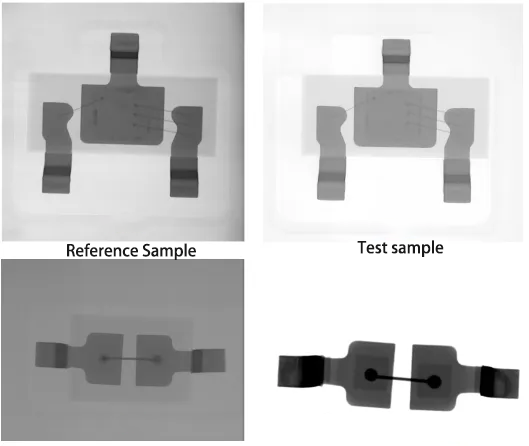
(Note: Internal frame structure, bond wires, and bond pads are consistent)
Through an X-ray comparison image of a highly-faked Nexperia sample (Left) against a genuine Nexperia sample (Right), we can expose the irreversible structural defects hidden within counterfeit Nexperia chips. The internal die size of the fake Nexperia sample (Left) is visibly smaller than that of the original component (Right). This is a critical factor, as in power discrete devices, the die size directly determines crucial parameters such as current carrying capability and thermal dissipation performance.
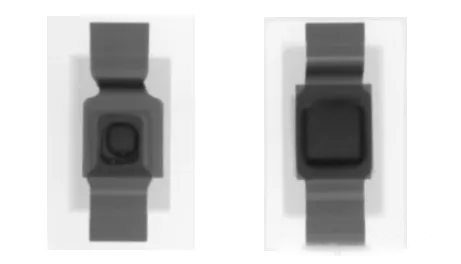
(Note: Internal structure mismatch)
Authentication Conclusion: The counterfeit Nexperia chip utilizes a smaller or lower-grade die to impersonate a higher-specification device. While the outer package remains identical, the internal structure and critical performance parameters are completely mismatched.
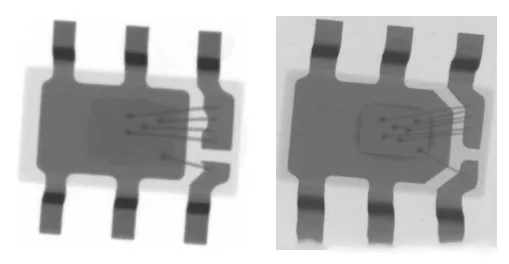
(Note: Left is high-fake sample, Right is genuine sample)
Compared to the genuine sample on the right, the high-fake sample on the left shows significant differences in the shape and die size of the die pad area, as well as the layout of the bond wires.
High-Fake (Left): The shape and dimensions of the Die Pad are inconsistent with the original manufacturer's design, which can severely compromise thermal dissipation and signal integrity.
Authentic (Right): The internal Die Pad structure is highly standardized, and the bond wire distribution strictly adheres to rigorous design specifications.
This internal mismatch in the frame structure and bond wires—often a result of using a non-OEM die or cheap packaging processes—is considered conclusive evidence that the component is not an authentic product.
3. Decapsulation (Destructive Analysis) – The Ultimate Confirmation
Decapsulation, or "de-capping," is the definitive professional method for final authentication of the die manufacturer and core technical parameters. It is crucial to note that, unlike Integrated Circuits (ICs), the surface of a Nexperia power discrete device (such as a MOSFET) typically lacks complex identification markings.

(Note: The wafer size and structure are basically the same)
Therefore, after decapsulation, the focus must shift entirely to core comparison points: Die Size (requiring precise measurement for an exact match) and the Internal Structural Layout. This technique is invaluable for identifying "White Label" and "Re-marked" parts. A total mismatch in die size and structure indicates a "White Label" part from an unknown manufacturer, while parts with matching structure but falsified specifications ("Re-marked" die) will require further confirmation through subsequent electrical testing.
4. Summary and Defense Strategy
No single counterfeit detection method offers absolute security. Only the three-step "Combination Punch"—Visual Inspection → X-RAY → Decapsulation—provides the highest level of assurance. However, professional testing demands expensive equipment and highly experienced technical teams.
We at Nantian Electronics are professional electronic component distributors and maintain an expert chip authentication team equipped with advanced laboratory facilities. Our expertise extends across the products of all major semiconductor manufacturers, and we possess extensive experience in authenticating parts from companies like Nexperia.
We have established a comprehensive "Golden Sample Library" for stringent comparison, and provide rigorous electrical characteristics testing (such as I-V curves and switching characteristics) to guarantee that component performance and reliability meet OEM specifications.
To build an impenetrable secure supply chain, we strongly recommend:
Sourcing Strategy: Purchase directly through reliable, tested channels like Nantian Electronics to eliminate the risk of semiconductor counterfeiting at the source.
Service Partnership: Utilize our professional chip testing services for independent, third-party verification of your critical inventory, ensuring 100% genuine incoming material.
Management Practice: Partner with us to establish your formalized Material Risk Profile, standardizing your quality control and counterfeit detection procedures.
Choosing Nantian Electronics provides your product reliability with a professional, robust insurance policy backed by broad industry expertise.


