Sourcing IC chips from China can expand options for overseas OEM, EMS, and procurement teams, especially when normal channels are constrained. It can also add risk if the buyer treats a low quote as proof that the supplier, part number, documentation, quality plan, and logistics path are all sound.
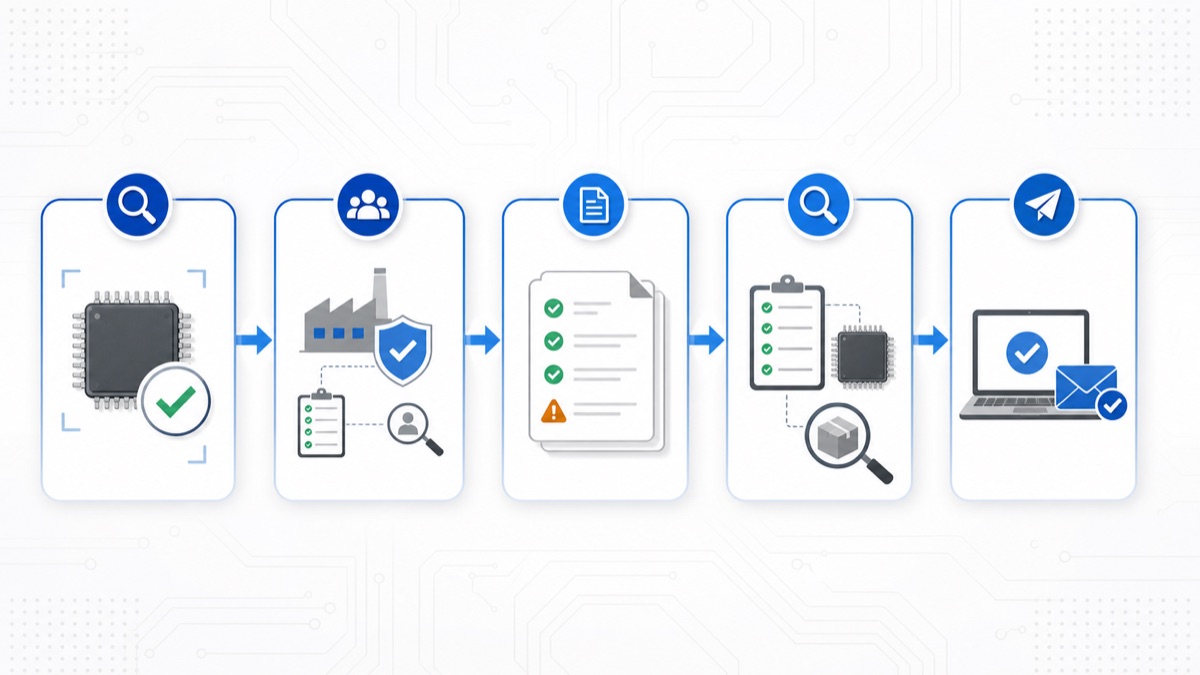
The safer approach is to make China IC sourcing a controlled process. Buyers should verify the exact manufacturer part number, confirm package and datasheet requirements, qualify the supplier, define documentation and inspection needs, and review logistics or import requirements before issuing a purchase order.
This guide explains how to source IC chips from China without increasing supply chain risk. It is written for teams that need real sourcing options, not marketplace hype. Availability, pricing, and lead time should be confirmed through RFQ.

Quick answer
To source IC chips from China without increasing supply chain risk, start with the exact part data, qualify the supplier, request clear documentation, define quality requirements, review compliance and logistics needs, and use RFQ to confirm availability, pricing, and lead time before purchase.
China sourcing is not automatically risky, and it is not automatically safe. The risk depends on how well the buyer controls the sourcing path. A strong process separates the quote from the purchase decision. The quote shows what may be possible. The buyer still needs to verify the part, supplier, documentation, inspection needs, and shipping requirements.
| Risk area | What can go wrong | Buyer control |
|---|
| Part identification | Wrong suffix, package, temperature grade, or revision is quoted | Provide full manufacturer part number, datasheet, and approved vendor limits |
| Supplier qualification | A supplier quote looks attractive but the sourcing path is unclear | Ask how the supplier verifies source, packaging, documentation, and handling |
| Counterfeit risk | A part may have remarking, mixed lots, poor storage, or unknown origin | Define documentation and inspection needs before purchase |
| Lifecycle risk | Obsolete, EOL, NRND, or last-time-buy parts may be hard to replace | Check lifecycle status and ask engineering to review alternates |
| Compliance risk | Screening, import classification, or customs documentation may be incomplete | Review restricted-party screening, HTS classification, and broker requirements |
| Logistics risk | Packaging, Incoterms, insurance, or shipping method may not match project needs | Confirm shipping terms, packaging requirements, and delivery constraints through RFQ |
The goal is not to remove every possible risk. The goal is to identify the risks early enough that procurement, engineering, quality, and logistics teams can decide what is acceptable.
When China IC sourcing makes sense, and when it does not
China IC sourcing makes the most sense when the buyer needs broader market access, faster supplier communication, or support for hard-to-find and shortage-driven parts. It can be useful for OEM and EMS buyers that already know the exact part number but need help reviewing available sourcing options.
It is less suitable when the buyer only has a vague description, wants an unapproved substitute, or expects price to override engineering and quality requirements. A cheap quote for an uncertain part can create more cost later through rework, production delay, quality disputes, or customer approval issues.
China sourcing is usually a good fit when:
The buyer has a full manufacturer part number and target quantity.
The part is hard to find through normal channels.
The buyer needs a sourcing team that can communicate with China-based suppliers.
Engineering can review alternates if the approved part is constrained.
Quality requirements can be stated before purchase.
China sourcing needs extra caution when:
The part number is incomplete or missing suffix details.
The application has strict automotive, medical, aerospace, telecom, or industrial reliability requirements.
The buyer needs traceability or documentation that has not been confirmed.
The supplier promises stock, price, or lead time without enough detail.
The buyer is unsure about import classification, screening, or customs documentation.
NTCHIP supports sourcing for IC chips and electronic components, including shortage-driven and hard-to-find components. Buyers should still treat each line as a separate sourcing decision, because one safe purchase does not prove that every future part from the same market has the same risk profile.
Start with exact part data before supplier outreach
The safest China IC sourcing process starts before supplier outreach. If the buyer sends incomplete part data, suppliers may quote parts that look close but do not match the real requirement. For ICs, a small suffix difference can affect package, temperature grade, packing method, speed grade, voltage range, firmware revision, or lifecycle status. For example, two parts may share the same base number while using different package options, packing formats, or temperature ratings.
Before requesting quotes, prepare a part-data file that includes:
| Field | What to provide | Why it matters |
|---|
| Manufacturer | Preferred manufacturer and any approved alternates | Prevents quotes for unapproved manufacturers |
| Full MPN | Complete ordering code, including suffixes | Reduces wrong-part and package mismatch risk |
| Package | QFN, BGA, SOIC, TSSOP, module, tray, reel, or other package detail | Helps match PCB footprint and assembly requirements |
| Quantity | Prototype, urgent demand, production quantity, and annual usage if known | Helps sourcing teams evaluate partial supply options |
| Target date | Required delivery date or production window | Shows which lines need escalation |
| Datasheet | Current datasheet or internal approved drawing | Supports electrical and mechanical verification |
| AVL limits | Approved vendor list, customer restrictions, or "exact only" notes | Prevents unsafe substitutions |
| Lifecycle notes | Known EOL, obsolete, NRND, last-time-buy, or replacement concern | Helps plan risk review |
| Quality needs | Date-code limits, packaging, inspection, documentation, or test requirements | Avoids late quote revisions |
Part data should be reviewed by procurement and engineering together when the component is application-sensitive. For replacements or alternates, compare electrical ratings, package, pinout, temperature range, timing, firmware behavior, qualification status, and customer approval requirements against the datasheet before purchase.
For alternate review, keep the approval path simple:
Compare the proposed alternate against the original datasheet and approved drawing.
Ask engineering or quality to confirm electrical, mechanical, thermal, firmware, and application fit.
Get customer or program approval when the build, contract, or AVL requires it.
Do not ask a supplier to "find something similar" for a design-critical IC unless engineering has defined what similar means. In shortage conditions, vague alternate sourcing can turn into a quality or compatibility problem.
Qualify the supplier, not only the quote
A low IC quote from China is only useful if the supplier can explain the sourcing path, documentation limits, packaging condition, and communication process. Supplier qualification should happen before the purchase order, not after a dispute starts.
Ask practical questions:
| Supplier question | What the answer should clarify |
|---|
| Is the quote for the exact manufacturer and full MPN? | Prevents suffix, package, or manufacturer mismatch |
| What is the source type? | Helps identify whether the offer is from normal distribution, surplus, brokered inventory, or another channel |
| Can packaging photos or lot information be reviewed before purchase? | Gives the buyer early visibility into condition and consistency |
| What documentation is available? | Clarifies invoice, packing list, certificate-type documents, manufacturer paperwork, or third-party inspection needs where applicable |
| What date code, lot, and packaging condition are being quoted? | Helps manage mixed-lot and storage-risk concerns |
| What happens if inspection requirements change? | Shows whether the supplier can support quality-sensitive buying |
| Which Incoterms and shipping options are available? | Prevents confusion about cost, risk transfer, and logistics responsibility |
| How long is the quote valid? | Reduces risk from stale availability or pricing |
The answer does not need to be perfect for every part. Some hard-to-find or obsolete ICs may have limited documentation. What matters is whether the supplier communicates limits clearly enough for the buyer to decide.
For China IC sourcing, avoid supplier claims that sound too broad: "all parts are guaranteed", "stock is always available", or "delivery is fixed" without line-item detail. A better sourcing partner will ask for the full MPN, quantity, target date, and quality requirements before treating the quote as final.
Control counterfeit and quality risk before purchase
Counterfeit and quality risk should be discussed before the order is placed. The buyer should define what evidence, inspection, and documentation are needed for the application. A general promise of authenticity is not a substitute for a controlled purchase process.
Useful risk controls include:
| Control | Buyer purpose | Notes |
|---|
| Packaging and label review | Check for obvious mismatch, damage, or inconsistent markings | Does not prove authenticity by itself |
| Visual inspection | Look for sanding, remarking, corrosion, bent leads, mixed lots, or poor handling | Should be performed by qualified staff or inspection partners when required |
| Date-code and lot review | Check whether the quoted lot fits the project requirement | Date-code limits should be stated in RFQ |
| Documentation request | Ask what documents are available before purchase | Documentation availability varies by source and part type |
| X-ray or further inspection discussion | Useful for high-risk parts or quality-sensitive applications | Requirements should be agreed before order |
| Sample or small-lot strategy | Reduce exposure before full production buying | Not always possible for urgent or obsolete lines |
| Engineering review | Confirm that alternates or replacements match the design requirement | Datasheet and customer approval may be required |
Testing and inspection scope should match the component type, application risk, purchase channel, and buyer requirements. A low-risk prototype line may only need basic documentation review, while an obsolete or safety-sensitive IC may need deeper inspection discussion before purchase.
NTCHIP's quality control context can support buyer discussions around inspection and verification requirements. Still, buyers should not assume that every component needs the same inspection level. A common logic IC for a prototype and an obsolete power-management IC for a production repair may need different review steps.
Quality-sensitive RFQs should state the required documents, inspection level, packaging condition, date-code limits, and any acceptance criteria before purchase. If the requirement changes after the quote, the sourcing team may need to re-check availability, price, lead time, and supplier fit.
Review compliance, logistics, and import risk early
China IC sourcing also needs a practical logistics and compliance review. The sourcing team may help with quotation and supplier communication, but the buyer, importer, customs broker, and compliance team may still need to review restricted-party screening, import classification, export-control exposure, taxes, duties, and documentation requirements.
For general supply chain risk context, the NIST Cyber Supply Chain Risk Management project is a useful reference. For screening support, buyers can review the Consolidated Screening List. For U.S.-bound shipments, the Harmonized Tariff Schedule can help buyers and brokers review classification questions.
Before purchase, clarify:
Importer of record and customs broker responsibility.
HS or HTS classification review where applicable.
Restricted-party screening process.
Country-of-origin and commercial invoice requirements.
Incoterms, freight method, insurance, and delivery address.
ESD packaging, moisture-sensitive packaging, reel or tray handling, and labeling requirements.
Whether the shipment must be split by urgency, project, or destination.
Advanced semiconductors, military or dual-use applications, restricted end users, sanctioned-party exposure, or country-specific import rules should trigger buyer-side compliance review before purchase. The sourcing team can help collect part and supplier information, but the buyer should decide the compliance path with the appropriate internal team or customs partner.
This article is not legal, tax, or customs advice. The point for procurement teams is simple: do not leave logistics and compliance questions until the parts are ready to ship. A quote can look attractive and still fail the buyer's internal approval path if documentation, shipping terms, or import responsibilities are unclear.
Build an RFQ that exposes risk early
A strong RFQ makes hidden risk visible. It should give the sourcing team enough detail to confirm the exact part, identify possible supply constraints, and ask the right questions before quoting.
Use this RFQ structure when you want to source IC chips from China:
| RFQ field | Include this detail | Risk reduced |
|---|
| Manufacturer and full MPN | Complete ordering code, suffix, and package | Wrong-part and package mismatch risk |
| Quantity | Immediate need, production need, and annual forecast if available | Partial-supply and planning risk |
| Target date | Required delivery date or build window | Schedule and logistics risk |
| Application sensitivity | Prototype, repair, industrial production, telecom, automotive, medical, or other context | Wrong inspection level or approval path |
| AVL or exact-only note | Approved manufacturers and alternates | Unsafe substitution risk |
| Datasheet or drawing | Current datasheet, drawing, or internal approved specification | Compatibility and engineering review risk |
| Quality requirements | Date-code limit, packaging, inspection, documentation, or test needs | Late rejection or dispute risk |
| Compliance documents | RoHS, REACH, certificate of conformity, country-of-origin, or customer-required declarations when applicable | Materials compliance and customer approval risk |
| Shipping requirements | Destination, Incoterms preference, carrier constraints, broker notes | Customs and delivery risk |
| Decision deadline | Quote validity and internal approval timing | Stale quote and availability risk |
Send your RFQ only after you know which parts are exact-only and which parts can be reviewed as alternates. If engineering approval is required, say so in the RFQ. If the application needs inspection, say that before the quote is finalized.
Buyers can request a quote from NTCHIP with the manufacturer, full part number, quantity, target date, and quality requirements. The sourcing team can then review options and confirm availability, pricing, and lead time through RFQ.
How NTCHIP supports China IC sourcing
NTCHIP helps global buyers review China IC sourcing options with an RFQ-first process. The buyer sends the exact part number, quantity, target date, and quality requirements. The sourcing team reviews available options, asks for missing details when needed, and helps the buyer compare sourcing paths before purchase.
| NTCHIP support step | What the team can help review | Buyer decision supported |
|---|
| RFQ intake | Manufacturer, full MPN, quantity, target date, and application notes | Whether the request is specific enough to quote |
| Missing data clarification | Package, suffix, AVL limits, datasheet, quality needs, and shipping constraints | Which details must be confirmed before supplier outreach |
| Sourcing option review | Available sourcing paths, documentation limits, quote validity, and supplier communication | Whether an option is worth further review |
| Documentation and quality discussion | Date-code limits, packaging condition, inspection needs, and required documents | Whether the buyer's quality requirements are clear before purchase |
This support is most useful when the buyer faces shortage, allocation, obsolete parts, unclear availability, or a BOM with several risk-sensitive IC lines. NTCHIP can help buyers organize part data, discuss documentation requirements, and review supplier communication. For quality-sensitive purchases, inspection requirements should be discussed before the order is placed.
NTCHIP should not be treated as a shortcut around engineering or quality approval. For replacements, alternates, and high-risk ICs, the buyer should compare datasheets, confirm package and pinout, review lifecycle status, and obtain internal approval where required.
To move faster, contact NTCHIP with:
Manufacturer and full MPN.
Quantity and target delivery date.
Preferred manufacturer or AVL restrictions.
Application or project context.
Date-code, packaging, inspection, or documentation requirements.
Shipping destination and logistics constraints.
For sourcing questions that need human review, contact NTCHIP and share the RFQ details with the China sourcing team.
FAQ
Is it safe to source IC chips from China?
It can be safe when the buyer uses a controlled process. Verify the exact part number, qualify the supplier, define documentation and inspection requirements, and confirm availability, pricing, and lead time through RFQ. Do not rely only on a low quote.
What is the biggest risk in China IC sourcing?
The biggest risk is usually not one single issue. It is a combination of incomplete part data, unclear supplier source, weak documentation, quality uncertainty, and rushed logistics. A structured RFQ reduces these risks before purchase.
How do I qualify a China IC supplier?
Ask whether the quote matches the exact manufacturer and full MPN, what documentation is available, what packaging and date-code details can be reviewed, what inspection options are possible, and which shipping terms apply. A supplier should explain limits clearly instead of making broad guarantees.
Should I accept substitute IC chips from a China supplier?
Only accept substitutes after engineering and quality review. Compare datasheets, electrical ratings, package, pinout, timing, temperature range, lifecycle status, and customer approval requirements. For controlled builds, alternates should follow the buyer's AVL or approval process.
What should I send in an IC chip RFQ?
Send the manufacturer, full part number, quantity, target date, datasheet, AVL limits, application sensitivity, quality requirements, shipping destination, and any documentation needs. The more complete the RFQ is, the easier it is to find useful sourcing options.
Can NTCHIP guarantee stock or lead time for China IC sourcing?
Availability, pricing, and lead time should be confirmed through RFQ for each line item. NTCHIP can help buyers review sourcing options, but the final quote depends on the exact part, quantity, source, quality requirements, and timing.
Send the manufacturer, full MPN, quantity, target date, and quality requirements to NTCHIP's China sourcing team for RFQ review. If the part is obsolete, shortage-driven, or quality-sensitive, include datasheets, AVL limits, date-code requirements, packaging preferences, documentation needs, and shipping destination.
NTCHIP can help review sourcing options and clarify what should be confirmed before purchase. Availability, pricing, lead time, inspection scope, and documentation should still be confirmed through the RFQ process for each line item.
Conclusion
China IC sourcing can help overseas buyers find options when normal channels are constrained, but it should be managed as a risk-control process. Start with exact part data, qualify the supplier, define documentation and inspection needs, review compliance and logistics questions, and use RFQ to confirm the commercial details.
For OEM, EMS, and procurement teams, the best result is not just a fast quote. It is a sourcing decision that procurement, engineering, quality, and logistics teams can support.
Contact NTCHIP's China sourcing team to review your IC chip RFQ, especially when the part is hard to find, obsolete, shortage-driven, or quality-sensitive.


