In industrial environments plagued by electromagnetic noise, stable data transmission is the backbone of any operational system. The DS3696N is a classic, single 5V RS-485/RS-422 differential transceiver that does more than just convert digital logic into noise-immune differential signals. Thanks to its exceptional reliability, it has become a cornerstone hardware solution for long-distance, multi-node bidirectional communication systems.
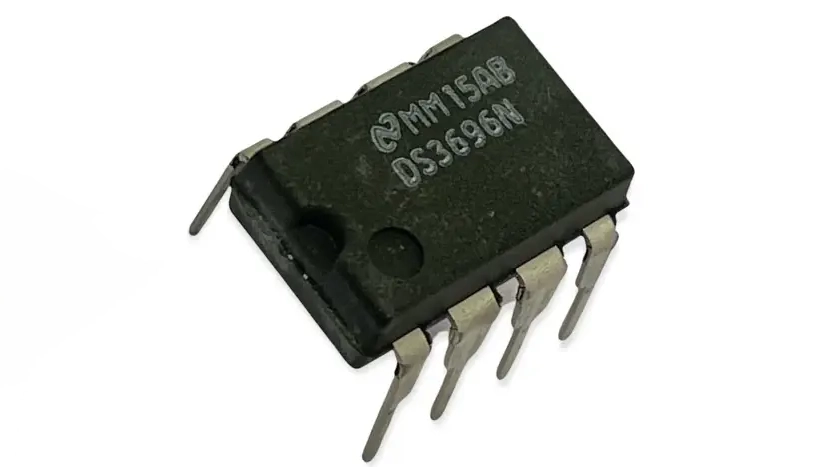
This chip is widely deployed across industrial automation, building management systems (such as Modbus networks), and distributed sensor arrays. With an expansive common-mode range of -7V to +12V, the DS3696N ensures precise and intact data delivery even in harsh conditions—whether you are dealing with 1,200-meter cable runs or significant ground potential differences. It is truly the indispensable "translator" for fieldbus architecture.
What sets the DS3696N apart from generic transceivers is its "secret weapon": built-in Thermal Shutdown protection. In the event of a bus short circuit or a fault-induced thermal overload, the chip automatically disables its outputs and provides real-time status feedback. This proactive defense mechanism dramatically increases system fault tolerance, ensuring the network remains rock-solid during unexpected failures. For engineers prioritizing high-reliability design, the DS3696N remains a top-tier choice.
DS3696N Key Technical Specifications Summary
The following parameters are based on typical conditions with a standard 5V supply voltage and an ambient temperature of 25°C.
| Category | Parameter | Value (Typical / Range) |
|---|
| Power | Supply Voltage (VCC) | 4.75V to 5.25V (5V Nominal) |
| Power | Quiescent Supply Current | ~28 mA |
| Bus Characteristics | Common-Mode Voltage Range | -7V to +12V |
| Bus Characteristics | Differential Input Threshold | ±0.2V |
| Bus Characteristics | Receiver Hysteresis | 70 mV |
| Transmission | Driver Propagation Delay | 15 ns |
| Transmission | Driver Pulse Skew | 2 ns |
| Transmission | Max Data Rate | 10 Mbps (Cable length dependent) |
| Loading | Max Number of Nodes | 32 Nodes |
| Loading | Receiver Input Resistance | 12 kΩ (Minimum) |
| Protection | Driver Short-Circuit Current Limit | ±250 mA |
| Protection | Thermal Shutdown (TS) | Integrated (Dedicated status feedback) |
| Packaging | Common Package Types | PDIP-8 (Through-hole) / SOIC-8 (SMT) |
Dual-Protocol Compatibility: A Bridge Between RS-485 and RS-422
The DS3696N fully meets EIA RS-485 standards while remaining backward compatible with RS-422. This dual-compatibility allows it to function seamlessly in both legacy unidirectional multi-drop systems (RS-422) and modern bidirectional multi-point bus systems (RS-485). For engineers, this versatility provides immense flexibility when switching communication protocols across different hardware, enabling "drop-in" replacements without redesigning the entire board.
Robust Multi-Point Capacity: Supporting Up to 32 Nodes
Industrial distributed systems often require hanging dozens of sensors or actuators on a single bus. The DS3696N features high-load driving capability, allowing up to 32 transceiver nodes to coexist on a single twisted-pair cable. This makes it an ideal solution for medium-scale industrial networks, ensuring signal integrity and clarity even when the bus is fully populated with devices.
Wide Common-Mode Range: The Ultimate Shield Against Ground Potential Shifts
In long-haul communication, transmitters and receivers are often separated by hundreds of meters, leading to inconsistent ground potentials. The DS3696N offers an expansive -7V to +12V common-mode range. Even when the bus is subjected to significant common-mode voltage offsets, the chip can precisely recover differential signals from the noise, handling complex industrial electromagnetic interference (EMI) with ease.
The "Secret Sauce": Active Thermal Shutdown Protection
This is the most competitive feature of the DS3696N. In multi-device setups, if two drivers attempt to transmit opposing data simultaneously (bus contention) or if a physical short-circuit occurs, the internal current spikes, causing rapid overheating.
Safety Mechanism: Once the internal junction temperature reaches a critical threshold, the chip triggers a Thermal Shutdown, automatically disabling the driver outputs.
Status Feedback: Unlike generic chips, it features a dedicated TS (Thermal Shutdown) pin. When protection is triggered, it signals the host microcontroller (MCU) via a logic level change. This "self-rescue and alert" design significantly reduces long-term maintenance costs and eliminates the risk of catastrophic circuit failure or "burn-outs."
Package Comparison: DS3696N vs. DS3696M

While the DS3696N and DS3696M are identical in terms of internal electrical performance and logic functionality, their physical housing (package) dictates very different application scenarios. Below is a detailed comparison:
| Comparison Item | DS3696N (PDIP-8) | DS3696M (SOIC-8) |
|---|
| Full Name | Plastic Dual In-line Package (PDIP) | Small Outline Integrated Circuit (SOIC) |
| Mounting Type | Through-Hole Technology (THT) | Surface Mount Technology (SMT) |
| Dimensions | Larger (~9.27mm x 6.35mm) | Compact (~4.9mm x 3.9mm) |
| Pin Pitch | 2.54 mm (100 mil) | 1.27 mm (50 mil) |
| Soldering Difficulty | Easy (Ideal for hand soldering) | Moderate (Requires reflow or fine-tip iron) |
| Serviceability | Excellent (Plug-and-play with IC sockets) | Fair (Requires hot-air rework station) |
| Thermal Performance | Good (Larger surface area for air cooling) | Standard (Relies on PCB copper pours) |
| Vibration Resistance | Standard (Longer leads) | Superior (Low profile, tight PCB coupling) |
DS3696N: The Classic PDIP-8 Through-Hole Package
The DS3696N utilizes the industry-standard PDIP-8 package. With its robust leads and wide spacing, it has long been a favorite among hardware engineers and electronics enthusiasts.
DS3696M: The Modern SOIC-8 Surface Mount Package
The DS3696M (often listed as DS3696MX) features the SOIC-8 package, which is the gold standard for modern electronic assembly.
How to Choose the Right Package?
When to Choose the DS3696N
For hobbyists or engineers in the R&D prototyping phase, the DS3696N is the perfect companion. Its wide pin pitch makes hand-soldering a breeze on breadboards or prototype boards, eliminating worries about damaging delicate pads. Furthermore, in legacy industrial systems with ample space, using a through-hole package with an IC socket allows field technicians to swap chips by hand—no hot-air rework station required. This is a massive advantage for small-batch production where long-term onsite maintenance is a priority.
When to Choose the DS3696M
If your design focus has shifted toward miniaturization and mass-production efficiency, the DS3696M is the definitive choice. Its low-profile SMT structure saves significant PCB real estate, allowing the transceiver to fit into sleek handheld devices or high-density communication gateways. It integrates perfectly with automated SMT lines, slashing assembly time and labor costs. Additionally, because the SOIC package has a lower center of gravity and fuses directly to the PCB surface, it offers far better mechanical stability in high-vibration environments like automotive systems or heavy mining machinery.
Pinout Definitions and Hardware Circuit Design
The DS3696N utilizes a standard 8-pin layout. While it may appear simple, every pin is engineered for industrial-grade stability and reliability.
Pin Function Deep Dive
To make it easier to understand, we can categorize the 8 pins into three functional groups:
1. Logic-Side Pins (Interfacing with MCU/Controller)
RO (Receiver Output): This pin outputs the data received from the bus. It converts differential signals into TTL logic levels, typically connected to the RX pin of your MCU.
RE (Receiver Enable): Active-LOW input. When pulled LOW, the receiver is active; when HIGH, the RO pin enters a high-impedance state.
DE (Driver Enable): Active-HIGH input. Pulling this pin HIGH enables the driver to transmit data onto the bus.
DI (Driver Input): The data input pin for the driver. Connect this to your MCU's TX pin to prepare signals for differential conversion.
2. Bus-Side Pins (Twisted-Pair Interface)
3. Power and Fault Monitoring
Pro Tip: Using the TS Pin as a System Monitor
Many beginners overlook the TS pin, but in high-end industrial design, it is a "lifesaver." If the bus experiences a severe overload or short circuit that causes the chip to overheat, the TS pin triggers a fault signal. By connecting this to an external interrupt on your MCU, your firmware can immediately halt data transmission and trigger a system alert. This proactive approach prevents hardware damage and mitigates fire hazards.
Typical Application: Connecting to Arduino or STM32
In most practical designs, the RE and DE pins are tied together to a single GPIO.
Transmit Mode: Set the control pin HIGH to send data; the receiver is disabled.
Receive Mode: Set the control pin LOW to listen to the bus; the driver is disabled. This half-duplex control scheme conserves MCU I/O resources and is the "golden standard" for RS-485 communication.
The Critical Role of the 120Ω Termination Resistor
At the physical start and end of an RS-485 bus, you must place a 120-ohm resistor in parallel between lines A and B.
Eliminating Reflections: When electrical signals travel through long cables and hit an unmatched impedance at the end, they bounce back—much like a wave hitting a wall. This reflection causes waveform distortion and leads to bit errors.
Energy Absorption: The 120Ω resistor matches the characteristic impedance of the twisted-pair cable, effectively absorbing the signal energy and preventing reflections.
Important Note: Resistors should only be placed at the two extreme ends of the bus. Do not add them to middle nodes, as this will place an excessive load on the drivers and weaken the signal.
Performance Advantages and Competitive Analysis
To better illustrate the capabilities of the DS3696, let’s perform a deep dive comparison against the MAX485, one of the most common general-purpose transceivers on the market.
DS3696 vs. MAX485: A Battle of Reliability and Noise Immunity
Hardware-Level Self-Protection: This is the DS3696’s biggest advantage. While the MAX485 includes basic protection features, the DS3696 features a dedicated Thermal Shutdown (TS) status pin. In the event of a bus short-circuit or multi-driver contention, the DS3696 doesn't just disable its output—it proactively reports the error. In automated systems requiring remote diagnostics, this makes the DS3696 significantly smarter and safer than the MAX485.
Transient Interference Filtering: In real-world testing, the DS3696’s receiver architecture demonstrates superior suppression of high-frequency interference. Its stable performance across the entire common-mode voltage range ensures that Bit Error Rates (BER) remain exceptionally low, even in electrically "noisy" industrial environments.
Power and Speed: Performance Under High Bandwidth Demands
For applications where communication speed is critical, the DS3696 delivers impressive results:
High-Speed Data Rates: While many general-purpose RS-485 chips are capped at around 2.5 Mbps, the DS3696 supports typical data rates up to 10 Mbps. This ensures rapid response times when handling large-scale sensor data uploads or real-time motion control signals.
Optimized Propagation Delay: The chip boasts extremely low driver and receiver propagation delays (typically around 15 ns). This minimal signal latency is vital for protocols with strict timing and synchronization requirements, such as Profibus or high-performance proprietary fieldbuses.
Comparison Summary: DS3696 vs. Standard Transceivers
| Performance Metric | DS3696 | General-Purpose (e.g., MAX485) |
|---|
| Max Data Rate | Up to 10 Mbps | Typically 2.5 Mbps |
| Thermal Feedback (TS) | Supported (Dedicated Pin) | Not Supported |
| Bus Node Capacity | 32 Nodes | 32 Nodes |
| Common-Mode Range | -7V to +12V | -7V to +12V |
| Primary Advantage | High Reliability w/ Fault Alert | Low Cost / Universal Availability |
Manufacturer Heritage: From National Semiconductor to Texas Instruments
The DS3696N carries a pedigree associated with two of the most illustrious names in analog electronics: National Semiconductor and Texas Instruments (TI).
The DS3696N was originally developed by National Semiconductor, a pioneer and global leader in analog circuits and industrial communication chips throughout the 1980s and 90s. The "DS" prefix stands for Digital Specific, a designation for their specialized line of high-performance data transmission products.
In 2011, industry titan Texas Instruments acquired National Semiconductor for $6.5 billion, merging two of the world’s most extensive analog portfolios.
Current Status: Following the acquisition, the DS3696N was integrated into TI’s massive Interface Portfolio. TI has maintained the original naming conventions and technical specifications, ensuring that the chip has retained exceptional consistency and supply chain stability over several decades.
Key Procurement Considerations for the DS3696N
When sourcing or stocking the DS3696N for production, focusing solely on price can be risky. We recommend evaluating your suppliers based on these three criteria to avoid low-quality or incompatible components:
Distinguishing Manufacturer Logos: Given the long lifecycle of the DS3696N, you may encounter "New Old Stock" (NOS) featuring the National Semiconductor (NS) logo alongside modern batches with the Texas Instruments (TI) logo. While the specs are compatible, for large-scale production, it is best practice to source TI-branded batches to ensure the latest technical support and manufacturing consistency.
Beware of "Refurbished" or Pull-offs: Because this chip is a staple in industrial gear, the market is flooded with "pulled" parts—chips desoldered from old boards, cleaned, and resold as new. Always verify that the packaging is factory-sealed and inspect pins for signs of secondary soldering. We strongly recommend using authorized distributors like Mouser, Digi-Key, or TI Direct to avoid "latent damage" that can cause intermittent communication failures in the field.
Precise Matching of Suffixes and Packages: Always verify the full part number. For example, "DS3696N" denotes the 8-pin PDIP (through-hole) package, while "DS3696M" or "DS3696MX" refers to the SOIC (surface mount) version. Additionally, check for temperature-specific suffixes (such as the "T" version, e.g., DS3695T), which typically indicates an extended industrial temperature range, ensuring the part survives your specific operating environment.


