Since the second half of 2025, the global memory market has entered a rare, broad-based price-up cycle. As we moved into Q4, the rally accelerated—Samsung, SK hynix, and Micron even paused price quotations or imposed production allocation controls. With profits surging and supply tightening at the same time, the market has been flooded with counterfeit memory chips, including refurbished pulls, recycled parts, re-marked chips, and secondary-packaged devices.
To help purchasing teams, engineers, and distributors avoid costly mistakes, this guide provides a systematic breakdown of how to authenticate memory chips, supported by real-world abnormal-case examples and a QC workflow that can be directly applied in practice.
1. Why Did Counterfeit Memory Surge in 2025?
| Reason | Description |
|---|
| OEMs halted quotations | Samsung, SK hynix, and Micron experienced phased shortages → distributors ran out → prices soared. |
| Short-term price spike | DDR4, DDR5, and NAND Flash rose 30–70% per quarter, creating huge profit incentives for counterfeiters. |
| Grey-market activity | Small workshops refurbish pulls, wash used chips, or recreate packaging at low cost. |
| High brand recognition | Samsung, Hynix, and Micron markings are easy to mimic; many buyers rely heavily on surface appearance. |
2. The 6 Core Methods to Verify Memory Chip Authenticity
In this section, each of the “six core verification methods” is expanded into actionable step-by-step procedures, required tools, common evaluation criteria, red flags, and real-world examples. You can directly use these as part of your QC handbook or internal inspection SOP.
1. Visual Inspection
Among all verification methods, visual inspection is always the first step—the lowest-cost and highest-efficiency filter. Most refurbished, pulled, re-labeled, and counterfeit parts can be flagged at this stage.
Although it seems simple, visual inspection is actually the most experience-dependent stage in chip quality control.
Required Tools
| Tool | Purpose |
|---|
| Magnifier (10–40×) | Inspect markings, corners, and defects |
| Microscope (30–100×) | Check sanding traces, laser code clarity |
| Cold light / ring light | Enhance surface texture contrast |
| Caliper / micro-measurer | Verify package dimensions |
| Lint-free wipes / swabs | Clean surface without damaging markings |
Visual Inspection Checklist (with Red Flag Indicators)
| Inspection Item | Normal Behavior (Authentic) | Abnormal Behavior (Counterfeit/Refurb) |
|---|
| Marking Text | Even contrast, sharp edges | Blurry, jittered edges, uneven depth, smudging |
| Surface Texture | Consistent matte or even glossy finish | Sanding marks, polishing traces, unnatural gloss |
| Package Corners | Smooth, no scratches | Knife marks, repairs, delamination |
| BGA Balls | Uniform ball shape, aligned grid | Oxidation, color change, inconsistent ball size |
| Bottom Laser Code | Sharp characters, consistent alignment | Ghosting, inconsistent depth, position shift |
| Package Dimensions | Fully matches datasheet | Wrong thickness, incorrect body size |
Common Counterfeit Appearance Clues
Surface sanded and reprinted with new markings
Excessive shine caused by high-temperature cleaning
Bottom laser code misaligned or inconsistent
Impossible date codes (e.g., Week 01 appearing in Q4 2025)
Visual inspection eliminates most low-quality counterfeit parts, but high-grade fakes require deeper verification.
2. OEM Code Verification (More Reliable Than Visual Inspection)
If visual inspection is “spotting fakes by eye,” then OEM code validation is “spotting fakes by logic.”
All major memory manufacturers (Samsung / SK hynix / Micron) use strict coding rules for Part Number, Date Code, and Lot Code.
Any deviation from these patterns is usually a serious red flag.
Structure of OEM Codes (Example)
| Field | Meaning | Example (Micron) |
|---|
| Part Number | Chip model & specification | MT41K256M16TW |
| Date Code (DC) | Year + production week | 2435 (Week 35 of 2024) |
| Lot Code | Batch / wafer traceability | LN23XYZ |
| Package Code | Package information | FBGA |
Common Code Abnormalities (Key Indicators)
| Abnormal Type | Typical Symptom |
|---|
| Unrealistic Date Code | Future dates or impossible week numbers |
| Invalid Lot Code Format | Wrong length, random sequence |
| Missing / Incorrect Suffix | CL → C1, TWB → TW8 |
| Date Code mismatches invoice | DC later than the supplier’s ship date |
| Non-existent P/N | Cannot be found in OEM documentation |
3. Electrical Testing (The Most Technical & Critical Verification)
Visual inspection and ID reading are not the final step.
The only way to determine whether a memory chip is actually usable is electrical performance testing.
This is the most professional—and time-consuming—method, suitable for bulk procurement, industrial systems, servers, automotive applications, or high-reliability products.
What Electrical Testing Includes
| Test Type | What It Checks | Applicable Chip Type | Importance |
|---|
| DC Test | Voltage, current, leakage | All memory chips | Detects aging, refurbished parts |
| AC Test | Timing, read/write speed | DRAM | Detects downgraded or fake dies |
| Functional Test (FT) | Erase/write cycles, bad blocks | NAND, eMMC, UFS | Directly indicates authenticity & lifespan |
| Thermal Cycle Test | Stability under temperature | Industrial/auto DRAM/NAND | Detects old or recycled chips |
Typical Counterfeit Electrical Behavior:
DRAM timing fails to meet JEDEC standards
Extremely slow write speeds
Certain memory addresses cannot be read
Errors appear after long-term high-temperature operation
Electrical testing is the most reliable method for confirming authenticity—if you have the right equipment.
4. Programmer ID Reading (The Simplest Yet Highly Effective Method)
Many buyers overlook this step, but the JEDEC ID is one of the few elements that cannot be counterfeited.
Even high-grade fake chips cannot alter the true internal manufacturer ID.
In the NAND/DRAM industry, this is one of the lowest-cost yet most accurate verification methods.
Common JEDEC IDs by Manufacturer (Examples)
If the reading returns 0x00, 0xFF, or an unknown vendor, it is highly likely to be counterfeit or severely defective.
Practical Steps
Prepare the programmer (e.g., TL866, SuperPro, Xeltek)
Place the chip in a test socket or clamp tool
Use Auto-Detect to identify the chip model
Read the Manufacturer ID / Device ID
Export logs and compare them with reference tables
For abnormal batches, retest at least 3 samples
Common ID Abnormalities
| Readout ID | Possible Cause | Judgment |
|---|
| 0x00 / 0xFF | Fake chip, blank die, damaged | High risk |
| Wrong manufacturer | Counterfeit, relabeled chip | Severe issue |
| Mixed IDs in batch | Mixed stock, non-original batching | Return required |
Examples:
| Chip | Authentic ID | Fake ID |
|---|
| Micron MT41K256 | 2C / 20 | 52 / FF |
| Hynix H27UCG8 | AD / D7 | 00 / 00 |
5. X-Ray Inspection (Internal Structural Verification)
As counterfeiting techniques evolve, more suppliers rely on X-Ray inspection to verify whether the internal structure of the chip matches the original manufacturer.
X-Ray can reveal:
Empty packages
Incorrect die count (e.g., single die disguised as dual-die)
Broken or inconsistent bonding wires
Signs of rework or refurbishment
X-Ray Inspection Checklist (Structural Criteria)
| Inspection Item | Normal Appearance | Abnormal Indicators |
|---|
| Die Count | Matches specification (e.g., dual-die) | Missing or incorrect count |
| Wire Bonding | Uniform, no broken wires | Breaks, irregular bonding |
| Die Position | Centered and symmetrical | Misaligned, shifted |
| Mold Compound | Even, fully filled | Voids, repair traces |
6. Comparing Against OEM Datasheets (Eliminates “Modified Part Numbers”)
During supply chain price spikes, contamination of the memory chip supply chain becomes more common.
The higher the market price climbs, the more frequent “mixed batches, relabeled parts, and manipulated part numbers” become.
Key Traceability Items
| Item | Description | Risk Indicator |
|---|
| COA / COC | OEM/authorized distributor certificate | Missing → High risk |
| Distributor Trace | Whether shipment can be verified | No record → Suspicious |
| Sensitive Batch Check | Any abnormal Date Codes | Duplicate/fake possible |
| Supplier Qualification | Authorized distributor or not | Non-authorized → Higher risk |
3. Common Types of Counterfeit Memory Chips
To help readers gain a clearer and more intuitive understanding of how counterfeit storage chips are typically produced, this chapter presents real inspection cases, highlighting the most common tampering methods and how to identify them.
DDR SDRAM (Refurbished & Re-Marked Units)
Basic Information
| Item | Details |
|---|
| Model | H5TQ4G63EFR-RDC |
| Brand | SK Hynix |
| Package | FBGA-96 |
| Type | DDR3 SDRAM |
Below are the top-view and bottom-view images of the submitted SK Hynix H5TQ4G63EFR-RDC sample.

(Note: actual images of the top and bottom view)
1. Typical Characteristics of Refurbished (Used / Pulled) Chips
The sample shows clear signs of being pulled from scrap PCBs. Components removed from old boards often retain:
Residual flux
Water stains
Oxidation marks
Under a microscope, the following defects are commonly seen:
Substrate edge delamination
Chipped or dented corners
Unnatural surface texture
In contrast, genuine new ICs have smooth, clean, and precisely cut substrate edges.
(Note: Insert microscope images showing surface wear or contamination.)
2. Sanded Surface & Reprinted Markings (Remarking)
The surface of this chip shows signs of sanding and re-marking, indicating that the original identification has been removed and replaced with new print.
Such chips typically exhibit:

(Note: re-marked surface.)
3. Reballing Marks (Reball Issue)
This sample shows obvious reballing, with defects including:
Inconsistent solder ball size
Rough or grainy ball surfaces
Ball misalignment / off-center balls
Uneven solder pads and irregular reflections
These are strong indicators that the chip has been removed, reballed, and resold as new.

(Note: reballing defects.)
4. Failed Reliability Tests (Acetone Wipe & Scratch Test)
Two simple but very effective authenticity tests were performed:
Acetone Wipe Test – Failed
Physical Scratch Test – Failed
These results strongly confirm the marking is counterfeit.

(Note: acetone test and scratch test comparison images.)
NOR Flash Inspection
1. Top View & Bottom View (Submitted Sample)
Compared with DDR SDRAM, counterfeit NOR Flash devices are usually more subtle and harder to spot from appearance alone. Although the sample looks relatively clean on the surface, several inconsistencies in the marking and package details immediately triggered suspicion.

(Note: actual top and bottom view images.)
2. Marking Anomalies
Multiple marking irregularities were detected—these issues commonly appear in fake-brand material or third-party clone chips:
Font style does not match official MXIC markings
Uneven spacing between characters
Inconsistent marking depth; some areas are too shallow
Localized blurring in the printed text

(Note: anomaly image)
3. Pin Oxidation Observed Under Microscope
Under microscopic examination, significant oxidation was found on the pins.
| Inspection Item | Genuine New Chip | Submitted Sample |
|---|
| PIN Surface | Bright silver, reflective | Darkened, yellowed, black spots |
| Oxidation Status | No oxidation | Clear visible oxidation points |
| Flatness | Neat and uniform | Some bent or deformed pins |
Oxidation is typically seen in:
Old stock stored for long periods
Inventory exposed to excessive humidity
Refurbished or reclaimed components
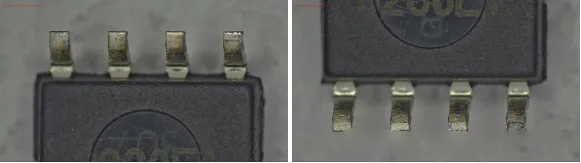
(Note: pin oxidation image)
4. Internal Structure Inspection (Completely Inconsistent)
After decapsulation, engineers identified major structural discrepancies:
| Internal Component | Genuine MXIC Structure | Submitted Sample |
|---|
| Leadframe | Symmetrical and well-formed | Rough, irregular layout |
| Die Size | Matches NOR Flash specification | Significantly smaller |
| Bonding Wires | Gold wires, neat alignment | Different material, messy layout |
| Bond Pads | Flat and consistent | Uneven, rough, protruding points |
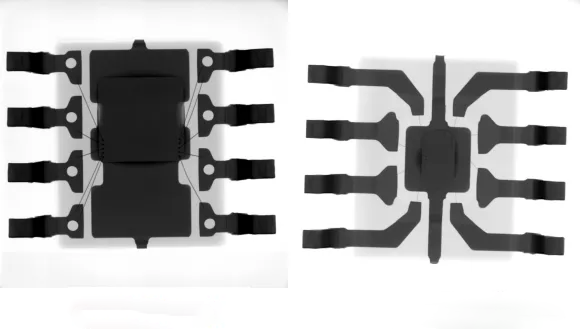
(Note: internal structure comparison image)
These deviations clearly indicate that the chip is not manufactured by MXIC, and the internal architecture does not match any legitimate NOR Flash of this model.
Conclusion
The sample is confirmed to be a counterfeit NOR Flash (clone device) with severe inconsistencies in package, pins, and internal structure.
Such components pose high risk in stability and reliability, and must not be used in any production environment.
4. How to Avoid Purchasing Counterfeit Components
During the global price surge of memory chips in the second half of 2025, counterfeit, refurbished, and reclaimed materials flooded the market, becoming one of the biggest hidden risks in the entire supply chain.
To help procurement teams improve their risk-identification capabilities in such a complex environment, we summarized five core and highly practical anti-counterfeit strategies.
These methods come directly from frontline testing labs, experienced distributors, and real-world failure cases—offering extremely high reference value.
1. Prioritize Authorized Distributors (Lowest Risk, Highest Transparency)
During periods of high counterfeit activity, choosing the right supply channel is the single most important defense.
Officially Authorized Distributors
Provide official supply chain traceability, stable quality, and the lowest risk.
Distributors with independent QC capabilities (e.g., Nantian Electronics)
These suppliers not only maintain stable sourcing channels but also operate their own incoming quality control (IQC) systems.
They typically provide:
When original manufacturers pause quotations or authorized agents face shortages, distributors with strong QC capabilities can significantly reduce procurement risk.
2. Always Conduct Sampling Tests Before Bulk Orders (Critical in High-Risk Periods)
Regardless of how reliable a supplier has been in the past, sampling inspection is mandatory for every large-volume purchase.
During price spikes and supply shortages (like 2025 H2), sampling becomes even more important.
Recommended sampling items:
| Test Item | Purpose |
|---|
| Visual inspection | Check markings, package condition, pin stains, grind marks |
| Microscopic check | Detect remarking, sanding, or surface rework |
| X-Ray inspection | Verify internal frame, leadframe, bonding integrity |
| Electrical testing | Validate capacity, read/write speed, erase reliability |
“No bulk order without sampling” should be a non-negotiable procurement rule.
3. Do Not Be Tempted by Prices That Are Too Low (Low Price = High Risk)
Memory chips are highly standardized components.
During shortage periods, there is no such thing as ‘super cheap genuine stock.’
If a quotation is 15%–30% below the market average, it is a red flag.
Low-priced materials often include:
Refurbished parts (remarked, sanded, reballed)
Reclaimed parts (pulled from scrapped devices)
Counterfeit clones (fake markings, fake model numbers)
Cleaned defective components
There is an old saying in the component industry:
“The cheaper the memory chip, the higher the hidden cost you’ll eventually pay.”
4. Build Your Own “Abnormal Batch Library” (Long-term Risk Reduction)
Professional supply chain teams typically maintain an internal Abnormal Batch Database, used to track counterfeit features and high-risk suppliers over time.
Recommended recording fields:
| Field | Description |
|---|
| Batch information | Lot Number, Date Code |
| Abnormal type | Remarking, pin oxidation, capacity mismatch, structure mismatch |
| Supplier source | Supplier name, risk level |
| Inspection photos | Top view / bottom view / internal structure |
| Disposition method | Return, quarantine, scrap |
| Repetition tracking | Whether similar risks occurred multiple times |
With database accumulation, your ability to predict and avoid market risks becomes significantly stronger.
5. Strengthen QC Standards During High-Risk Periods (e.g., 2025 H2)
2025 H2 was one of the most chaotic periods in the memory market, with counterfeit and refurbished materials appearing at record volume.
Companies should proactively increase QC thresholds during such times.
Recommended enhanced QC measures:
| Item | Standard Requirement | High-Risk Period Recommendation |
|---|
| Visual inspection | Sampling | 100% full inspection |
| X-Ray | Core batches only | All batches |
| Electrical tests | Random sampling | Increase sampling to 3%–5% |
| Supplier audit | Basic review | Enhanced background verification |
| Inbound process | Normal storage | New suppliers’ material must stay in isolation area pending QC |
| Internal review | QC only | QC + R&D dual approval |
The more chaotic the market becomes,the stricter the quality control must be.


