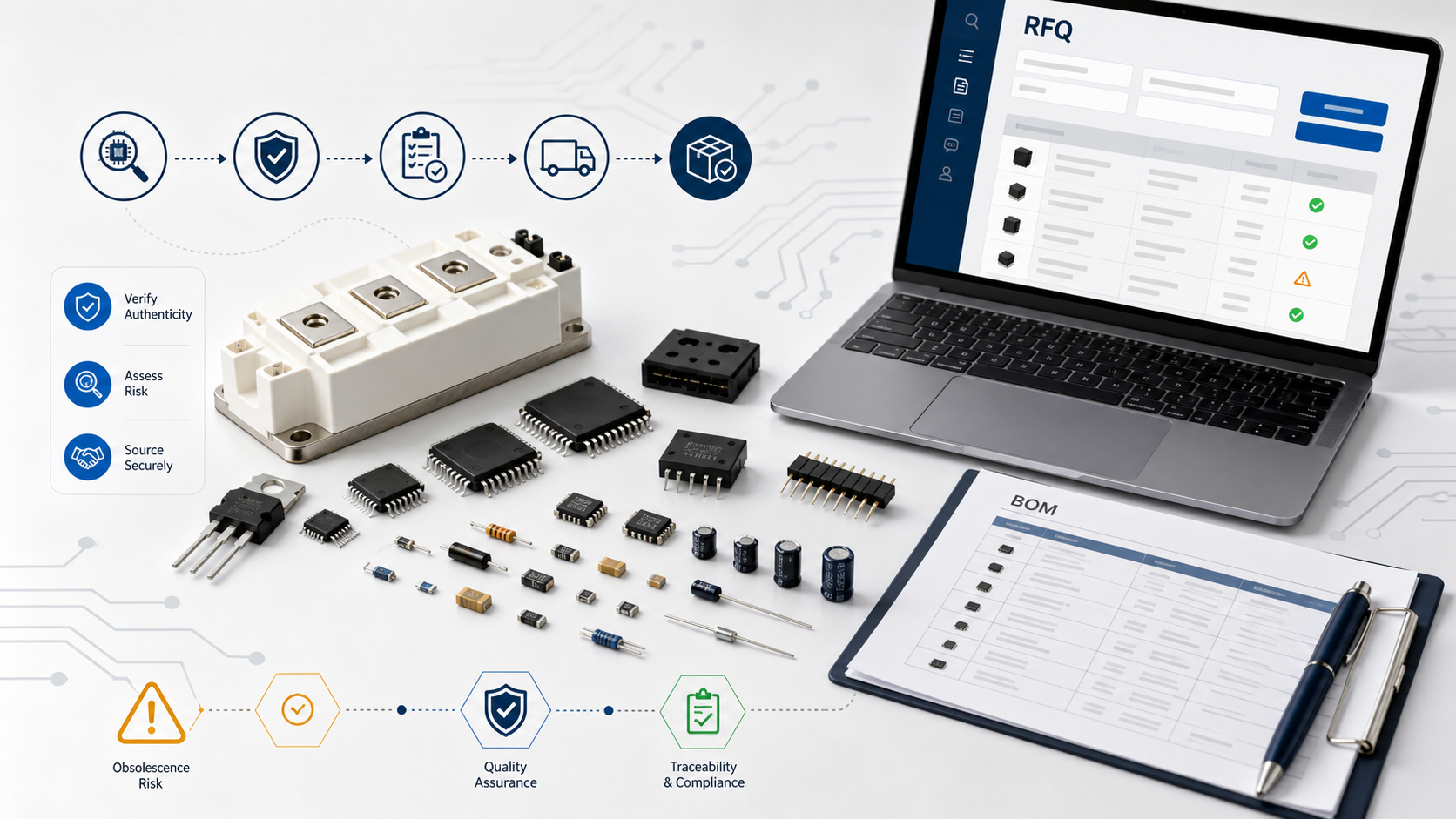
Obsolete electronic components can keep a product, repair program, or industrial system running, but they carry higher sourcing risk than active parts. The safe approach is to verify the exact part number, confirm lifecycle status, check documentation requirements, review quality risks, and request a quote with enough detail for a supplier to evaluate availability, pricing, and lead time.
For OEM procurement teams, EMS buyers, repair procurement teams, and distributors, finding the part is only the first filter. The harder question is whether the part can be sourced with enough confidence for the application.
NTCHIP supports buyers who need help with obsolete components, EOL components, hard-to-find parts, shortage sourcing, and BOM review. This guide explains the main risks and gives a practical sourcing process you can use before submitting a part number or uploading a BOM for RFQ.
What obsolete electronic components mean in procurement
An obsolete electronic component is a part that is no longer recommended, no longer manufactured, or no longer broadly available through normal supply channels. Buyers may also use related terms such as EOL components, discontinued components, end-of-life parts, legacy ICs, and hard-to-find electronic parts.
The lifecycle label matters because it changes the sourcing path. A part that is still active may be sourced through normal distribution. A part that is obsolete may require broader market search, documentation checks, date-code review, and a stricter quality-control discussion before purchase.
Common obsolete component scenarios include:
A legacy IC is required for a repair program.
An industrial controller or power supply still uses an older package.
A BOM includes a part affected by allocation, shortage, or lifecycle change.
A customer design is not ready for redesign, so a last-time-buy or replacement review is needed.
A distributor needs sourcing support for a part number that is not available through usual channels.
Before treating any part as safe to buy, verify the manufacturer, full part number, package, lifecycle status, datasheet, and application requirements.
Main risks when buying obsolete electronic components
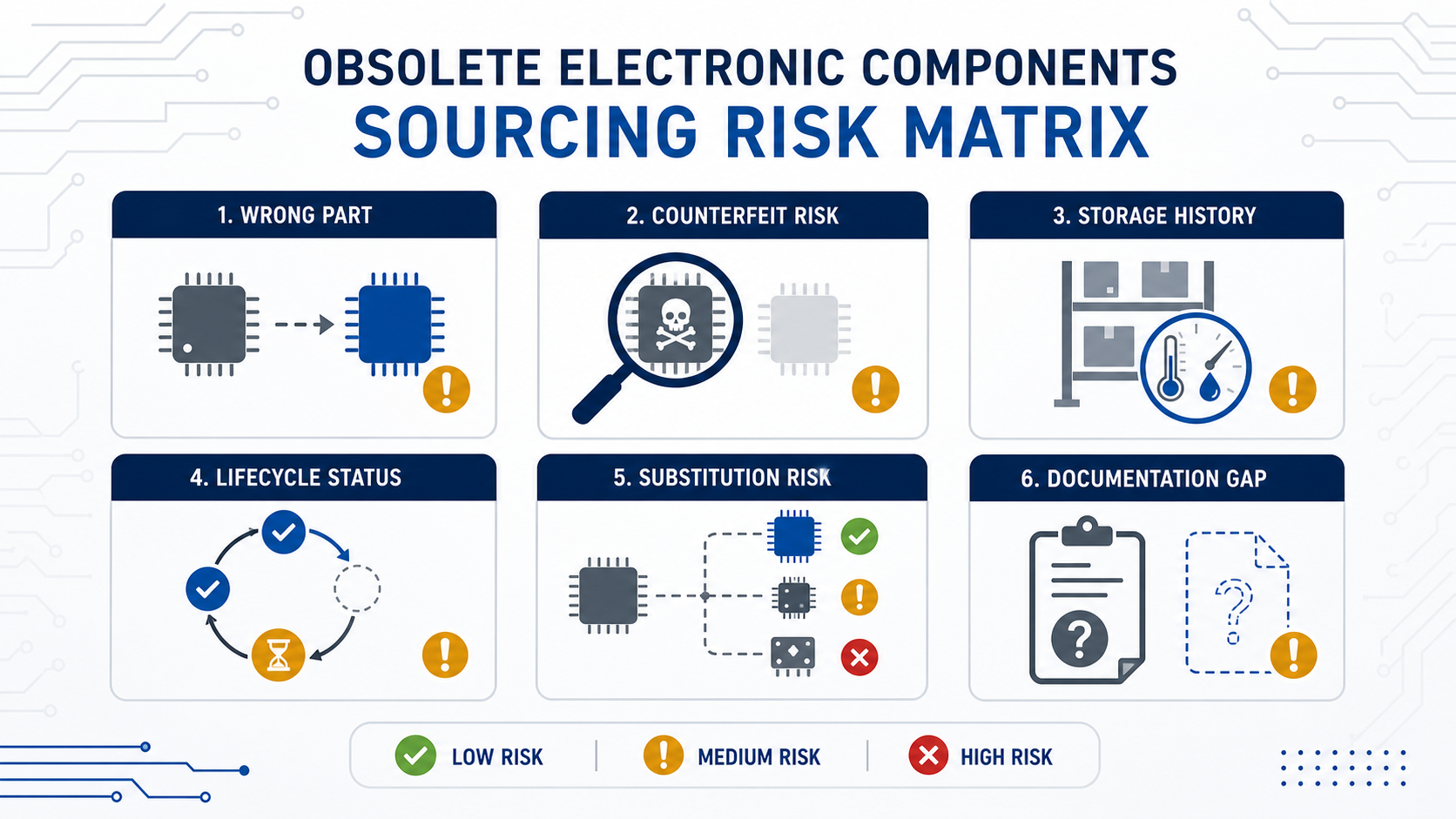
Obsolete parts are not automatically unsafe, but they require more careful procurement. The risk usually comes from weak information, uncertain handling history, unclear lifecycle status, or pressure to buy quickly during a shortage.
| Risk | Why it matters | What buyers should check |
|---|
| Wrong part number | A suffix, package code, temperature grade, or revision can change fit and performance. | Confirm the full manufacturer part number, package, marking, and datasheet. |
| Counterfeit or remarked parts | Scarcity can increase the chance of nonconforming or misrepresented components entering the market. | Ask what inspection, documentation, and supplier review options are available. |
| Unknown storage history | Older parts may have moisture, oxidation, ESD, or packaging concerns. | Review date code, packaging condition, MSL needs, and handling requirements. |
| Lifecycle misunderstanding | "Obsolete," "NRND," "EOL," and "discontinued" may not mean the same thing across manufacturers. | Check manufacturer lifecycle pages, PCN/EOL notices, or datasheet status. |
| Unsafe substitution | A similar part may differ in pinout, package, voltage, timing, firmware, or thermal behavior. | Require engineering and datasheet verification before approving alternates. |
| Documentation gaps | Repair, medical, automotive, industrial, or export-sensitive applications may need more records. | Define required documents before RFQ, not after purchase. |
| Urgency-driven decisions | Shortage pressure can lead to overpaying or accepting weak verification. | Separate "need-by date" from minimum quality and documentation requirements. |
For quality-sensitive sourcing, review NTCHIP's quality-control support and confirm which checks are appropriate for the part type and application before placing an order.
A safer process for sourcing obsolete components
A safe obsolete component sourcing process starts with exact identification and ends with a documented RFQ decision. The process below is useful for single urgent part numbers and larger BOM reviews.
1. Confirm the exact component identity
Start with the full manufacturer part number, not a shortened internal code. Include suffixes, package codes, temperature grade, speed grade, voltage option, packing type, and any approved manufacturer list requirements.
If the part came from a legacy BOM, compare it against the original datasheet and any engineering notes. If the marking on the component differs from the BOM description, treat it as a verification issue until resolved.
2. Check lifecycle and sourcing context
Look for manufacturer lifecycle pages, PCN/EOL notices, datasheet status, or distributor notices. Manufacturer terminology can vary, so keep the evidence rather than relying only on a verbal label.
Useful public reference points include Texas Instruments product lifecycle information, Microchip product change notification resources, and the SAE AS5553 standard page for counterfeit electronic parts avoidance. These references should support your review; they do not replace part-specific supplier verification.
3. Define the acceptable sourcing route
Different applications tolerate different sourcing routes. A repair program for non-critical equipment may have different requirements from an aerospace, medical, automotive, or high-reliability industrial program.
Before RFQ, decide whether you can accept:
Same manufacturer and exact part number only
Same part number with specific date-code limits
New old stock with documentation review
Approved alternates after engineering review
Replacement parts only after datasheet and qualification checks
4. Request quote details with verification requirements
When submitting an RFQ, provide quantity, target date, acceptable date-code range if applicable, packaging preference, end application sensitivity, and documentation needs. A complete RFQ helps the supplier respond with fewer assumptions.
You can submit an exact part number through NTCHIP's request a quote page, or share a BOM for sourcing review when multiple obsolete or hard-to-find items need to be checked together.
5. Review offer details before purchase
Do not evaluate an obsolete component offer only by price. Review manufacturer, full part number, quantity, date code, packaging condition, documentation, inspection options, and any limits stated by the supplier.
Availability, pricing, and lead time should be confirmed through RFQ because obsolete component supply can change quickly.
6. Keep the decision record
For internal control, keep a record of the RFQ, supplier response, datasheet reference, lifecycle evidence, approved alternates, and any quality-control notes. This protects future repair, reorder, and audit discussions.
Obsolete component RFQ checklist
The better the RFQ, the easier it is to reduce sourcing risk. Use this checklist before sending an obsolete electronic components request.

| RFQ field | What to provide | Why it helps |
|---|
| Manufacturer | Original manufacturer name or approved manufacturer list | Prevents confusion with similar part numbers. |
| Full part number | Include all suffixes and package codes | Reduces wrong-package and wrong-grade risk. |
| Quantity | Required quantity and acceptable split shipment, if any | Helps evaluate realistic sourcing options. |
| Target date | Need-by date and project urgency | Helps prioritize shortage or repair sourcing. |
| Package and packing | Tube, tray, reel, cut tape, or other preference | Supports handling and production planning. |
| Date-code requirement | Acceptable range or "no restriction" if approved | Important for older stock and quality review. |
| Datasheet or approved spec | Attach or reference the required datasheet revision | Reduces unsafe substitution risk. |
| Application sensitivity | Industrial, repair, medical, automotive, telecom, or other context | Helps define quality and documentation expectations. |
| Documentation needs | Photos, CoC, test report, traceability, packaging photos, or other requirements | Prevents late-stage mismatch between quote and internal process. |
| Alternate policy | Exact match only or alternates allowed after review | Avoids unapproved substitution. |
If your request includes many line items, upload the BOM or send it through NTCHIP's contact page so the sourcing team can review part numbers, quantities, and risk notes together.
When to consider alternates, redesign, or BOM support
Sourcing the original obsolete part is not always the best long-term answer. If the same shortage keeps recurring, or if the available supply carries high risk, a replacement review or redesign discussion may be needed.

Consider alternate or redesign review when:
The part is no longer available in reliable quantity.
The only offers have unclear documentation or unsuitable date codes.
The product will remain in production for multiple years.
The part affects safety, compliance, firmware, timing, thermal behavior, or field reliability.
The BOM contains multiple EOL or shortage-risk components.
Replacement sourcing must be handled carefully. A cross-reference, marketplace suggestion, or similar package is not enough. Buyers and engineers should compare electrical ratings, pinout, package, footprint, timing, thermal limits, firmware dependencies, qualification status, and application requirements before approving any substitute.
For multi-line sourcing, NTCHIP's products and component sourcing page can support BOM-level review across ICs, IGBT modules, connectors, passives, relays, crystals, and other electronic components.
How NTCHIP supports obsolete and hard-to-find component sourcing
NTCHIP is an independent electronic components distributor focused on RFQ support, broad component sourcing, and procurement-risk reduction. For obsolete electronic components, the useful role of a sourcing partner is to help buyers clarify the exact requirement, search suitable supply channels, and communicate quality and documentation expectations before purchase.
NTCHIP can support requests involving:
Obsolete and EOL ICs
Hard-to-find semiconductors and modules
Shortage-driven sourcing
IGBT modules and power components
Memory ICs, optoelectronics, connectors, passives, relays, crystals, and oscillators
BOM review for OEM, EMS, repair, and distributor buyers
The safest RFQ conversation includes both commercial and technical details. Share the full part number, manufacturer, quantity, target date, application context, datasheet, packaging needs, and documentation requirements. NTCHIP can then respond with available sourcing information for manual review.
Learn more about NTCHIP's sourcing role on the NTCHIP website or send a specific request through Request a Quote.
FAQ: obsolete electronic components sourcing
What are obsolete electronic components?
Obsolete electronic components are parts that are no longer recommended, no longer manufactured, or no longer broadly available through standard supply channels. Buyers may also call them EOL, discontinued, legacy, or hard-to-find components.
Is it safe to buy obsolete components?
It can be safe when the part identity, source, condition, documentation, and application requirements are properly reviewed. The risk is higher than buying active components, so buyers should verify manufacturer, part number, package, date code, lifecycle status, datasheet, and quality requirements before purchase.
What information should I include in an obsolete component RFQ?
Include manufacturer, full part number, quantity, target date, package, packing preference, acceptable date code, datasheet, application sensitivity, and documentation requirements. If alternates are acceptable, say whether engineering approval is required.
Can an obsolete part be replaced by a newer component?
Sometimes, but never assume compatibility from a similar part number or package. Compare datasheets, electrical ratings, pinout, footprint, timing, thermal behavior, firmware dependencies, and qualification needs before approving a replacement.
What is the difference between obsolete, EOL, and NRND?
The exact meaning depends on the manufacturer. In general, EOL means the manufacturer has announced an end-of-life process, obsolete often means the part is no longer active or produced, and NRND means not recommended for new designs. Buyers should check the manufacturer's current lifecycle information or PCN/EOL notice.
How can NTCHIP help with obsolete electronic components?
NTCHIP can help buyers review obsolete, EOL, shortage-driven, and hard-to-find component requests through RFQ and BOM support. Availability, pricing, and lead time should be confirmed through RFQ for the exact part number and quantity.
Send your obsolete part number or BOM for review
Obsolete electronic components require more than a quick availability search. The safer process is to confirm the exact part, check lifecycle evidence, define documentation needs, review quality risks, and compare any alternatives through datasheet and engineering review.
If you need help sourcing an obsolete, EOL, or hard-to-find part, send NTCHIP the manufacturer, full part number, quantity, target date, and any quality or documentation requirements. For multi-line projects, upload your BOM so the sourcing team can review risk across the full list.
Submit an obsolete part number or upload your BOM for RFQ.


